
Trusted Worldwide Adapted for India
Powered by the Cloud.
Trusted Worldwide
Adapted for India
Powered by the Cloud.
1. Executive Summary
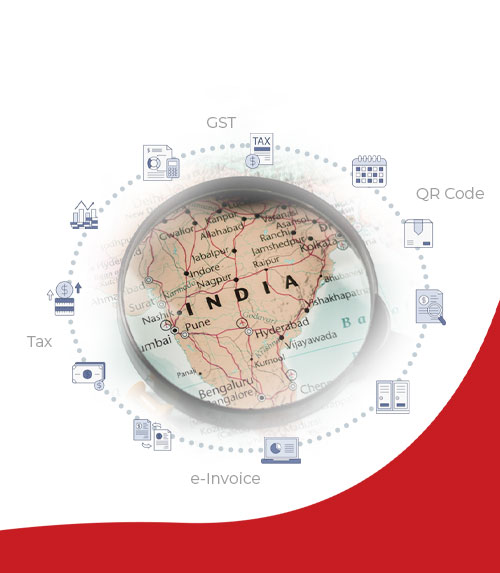
India’s regulatory landscape is evolving faster than ever. presents challenges for businesses. These include Complex Goods and Services Tax (GST) structures, Tax Deducted at Source (TDS) regulations, Tax Collections at Source (TCS) and mandatory e-invoicing requirements adds continuous pressure on the finance teams.
Many global modern ERP systems lack native support for India specific compliance and do not support these localized requirements. As a result, companies are forced to rely on external integrations, manual processes, or partial workarounds, spreadsheets, etc, leading to inefficiencies, delays, audit risks and higher operating cost.
Acumatica ERP is a cloud-native system that now includes a dedicated India Localization Add-on developed natively within the Acumatica platform.
This solution empowers Indian organizations and businesses to remain compliant, reduce manual efforts, simplify daily operations and achieve seamless financial accuracy.
This whitepaper introduces the India Localization Add-on and shows how it addresses India-specific legal requirements with an integrated approach.
Key benefits of this localized solution include:
- Global cloud ERP with native India compliance
- Automated GST configuration, and reporting and document generation
- E-invoice creation with IRN validation and QR code printing
- Built-in TDS calculation, and reconciliation
- Real time data accuracy
- Reduced reliance on third-party tools
- Faster financial closing and audit readiness
- Scalability with no user-based licensing restrictions
- Lower total costs of ownership compared to legacy ERP systems
With Acumatica’s native India localization, businesses can use the full power of the Acumatica ERP platform while confidently complying with India’s dynamic legal and tax guidelines.

2. Introduction to the Indian business environment:
India’s business landscape is one of the fastest-growing globally, supported by large-scale digitization, a thriving SME ecosystem, an expanding consumer base, strong digital infrastructure, and government initiatives that support entrepreneurship and business modernization.
India’s Growth Story
- Diverse industry sectors including manufacturing, pharma, logistics, retail, BFSI, IT, and agribusiness
- $5T economy target by 2030
- 100% e-Invoicing mandate for large businesses
- 60M+ SMEs driving GDP and employment
- Digitization fuelled by Digital India, Make in India, and Startup India initiatives
- Increasing emphasis on compliance, transparency and audit preparedness
The country’s business environment consists of:
- Diverse industry sectors: Manufacturing, retail, pharmaceuticals, logistics, BFSI, IT services, and agribusiness
- Rapid growth among SMEs: Over 60 million small and mid-sized businesses significantly contribute to GDP and employment
- Push for digitization: Government initiatives like Digital India, Make in India, and Startup India are speeding up digital adoption
- Compliance as a growth driver: Businesses increasingly need to be audit-ready, digitally compliant, and transparent in their operations.
This ecosystem presents great potential but requires precision and agility in navigating India’s regulatory framework. India’s Regulatory Complexity India’s legal and tax systems are complex and change frequently, demanding that ERP systems be highly adaptable.
India’s Regulatory Complexity
The Goods and Services Tax (GST) Act:
A unified tax system in India that requires registration, return filings, and e-invoicing. Frequent changes in tax rates, HSN codes, and filing schedules require ongoing system updates.
The Income Tax Act, 1961:
Governs corporate taxation and mandates deduction and remittance of Tax Deducted at Source (TDS) and Tax Collected at Source (TCS). Noncompliance leads to interest, penalties, and disallowance of expenses
The Companies Act, 2013:
Outlines requirements for statutory audits, financial disclosures, and governance standards. ERP systems must support audit trails, secure access, and detailed ledger management.
E-invoicing mandate under GST (Rule 48):
Businesses exceeding certain turnover thresholds must generate invoices with an Invoice Reference Number (IRN) and QR code, validated through the NIC portal in real time.
Legacy Tax Support (VAT & Service Tax)
While India currently operates under a unified Goods & Services Tax (GST) regime, Acumatica’s core tax engine is built to support GST, VAT, and Service Tax natively.
Built-In Support for Multiple Tax Models
Acumatica’s tax framework allows configuration of:
- GST (CGST, SGST, IGST) – fully supported and tested through Greytrix’s India Localization add-on
- VAT – supported through Acumatica’s native VAT computation engine
- Service Tax – supported natively and can be enabled if regulatory requirements return in the future
This means that if India reintroduces VAT or Service Tax, organizations can quickly re-enable these tax structures without custom development, relying on Acumatica’s existing capabilities.
TCS Handling (Workaround Via Native Tax Engine)
While TCS is not natively supported, organizations can still manage TCS obligations with:
- Configurable tax rates
- Custom tax categories
- Automated percentage-based calculations
- Reporting through standard tax registers
Greytrix consulting teams assist customers by configuring TCS within the tax engine as a functional workaround, ensuring operational continuity.
Fixed Assets & Purchase Tax Handling
Asset capitalization is managed through the AP module at the
time of bill creation
Purchase tax, GST, and applicable tax rules are
automatically applied during AP billing
Ensures correct capitalization values, depreciation bases,
and compliance alignment
3. Key challenges Faced by Businesses in India:
GST complexity and realtime accuracy needs:
India’s Goods and Services Tax (GST) system combines Central and State taxes into one framework but divides liability into three categories:
- CGST (Central GST): Charged by the central government on intra-state sales
- SGST (State GST): Charged by the respective state government on intra-state sales
- IGST (Integrated GST): Applied to inter-state transactions and imports
Each transaction must be classified correctly, with tax applied and reported as needed. Business activities such as procurement, sales, stock transfers, and service delivery must be analyzed for the correct tax applicability and place of supply. The requirement for invoice-wise return filings, e-way bill generation, and periodic reconciliations means ERP systems need to automate compliance while maintaining real-time accuracy.
TDS Complexity and threshold calculations
TDS (Tax Deducted at Source) is a key compliance mechanism under the Income Tax Act, requiring accurate rate determination and timely payment.
Challenges include:
- Dynamic applicability: TDS rates vary based on transaction type, vendor/resident status, and PAN availability.
- Threshold calculations: Tax applicability depends on the total value of transactions over the financial year.
- Multi-rate matrix: Payments such as rent, contract labor, professional fees, and commission all attract different rates.
- Reporting and reconciliation: Quarterly returns, Form 16/16A generation, and reconciliation with the 26AS/TDS portal require seamless ERP integration. Failure to comply can lead to penalties, interest, and the disallowance of expenses, making automated TDS configuration essential for ERP systems.
By enabling automation and centralized control, localized ERP systems lessen the burden of regulatory complexity, allowing businesses to remain compliant, agile, and audit-ready in India’s changing governance landscape.
4. India localization features in Acumatica ERP
An ERP system must do more than provide generic global functionalities; it needs to include localized capabilities that meet statutory, regulatory, and operational requirements. Below is a list of key localization features tailored for Indian businesses:
1. GST Configuration & Compliance
- Multi-GST Support: Manage CGST, SGST, and IGST based on the transaction type and location.
- Place of Supply Logic: Automatically apply tax based on supply rules (intra-state vs. inter-state).
- GSTIN Validation & PAN Mapping: Supports customer/vendor registration verification.
- Invoice Formats: Generate compliant tax invoices, bills of supply, and credit/debit notes
- GSTR Reports: Automatically prepare GSTR-1 and GSTR-3B formats.
2. E-Invoicing Enablement
- IRN Generation: Integrate with the Invoice Registration Portal (IRP) to generate Invoice Reference Numbers
- QR Code & Acknowledgment Number: Automatically print on final invoices.
- E-Invoice Cancellation & Reissue: Process changes or voiding within the required timelines.
- Real-Time Data Sync: Keep every invoice ERP and compliance-ready at the same time.
3. TDS Configuration
- Flexible TDS Categories: Set up categories like 194C (contractor), 194J (professional), etc.
- Auto Calculation & Deduction: Based on thresholds, rate types, and vendor settings.
- Return Reports: Generate Form 26Q, payment challans, and eTDS-ready files.
4. Industry-Specific Customizations
- E-Way Bill Automation: Create transport documents for supply chain and logistics businesses.
- Import/Export Duty Management: For trading, pharmaceutical, and manufacturing firms involved in cross-border trade.
5. Reduced Dependence on Third Party TOOLS
- Most India compliance is handled natively via Greytrix’s certified localization package.
6. Mobility as a Differentiator
- Acumatica’s mobile-first platform amplifies India-ready workflows for field sales, dispatch, service engineers, and finance teams.
5. Business Benefits of using Acumatica cloud ERP
Ensured statutory compliance:
Reduce risks of penalties and legal issues by automating tax compliance.Lower operational costs:
Streamline processes, minimize manual errors, and improve efficiency.Better financial accuracy and reporting:
Get real-time visibility into financial data, automate reconciliation, and ensure accurate reporting.Enhanced audit readiness:
Keep detailed records and create compliance reports, simplifying audit processes.Scalability and Flexibility:
Easily adjust to future business growth and changing regulations. 6. Conclusion
- India’s complex regulatory landscape varied tax structure, and sector-specific compliance requirements makes it essential for businesses to adopt a modernn ERP system that is not just globally capable but locally smart.
- The India Localization Add-on for Acumatica ERP is designed to meet these specific needs. It provides native support for GST, TDS, E-Invoicing, payroll compliance, and statutory reporting. This solution removes the need for third-party integrations or manual processes, helping businesses stay compliant and efficient.
- Choosing a localized modern ERP solution is not just about meeting regulatory requirements. It is a strategic decision. It enables businesses to scale confidently, respond to legal changes quickly, and streamline operations with precision. For Indian businesses looking to stay competitive in a changing digital economy, localization is essential. At the same time, Acumatica’s India localization does more than ensure local compliance, it equips organizations with a globally scalable platform, giving them the flexibility to expand into new markets without changing systems or disrupting operations.
Contact the ERP expert/ provider for a consultation.
Acumatica, combined with Greytrix India Localization, delivers one of the most comprehensive India-ready ERP stacks in the market. With native support for GST, TDS, E-invoicing, Excise, Fixed Assets, and a modern mobile-first platform, Indian companies benefit from:
- Accurate statutory compliance
- Streamlined field operations
- Faster audits and financial closings
- Reduced manual work
- Scalable automation for future regulations
While several mobile India-local features are already available natively, additional enhancements—UPI payments, POD workflows, TCS alerts, and MSME modules—present strong opportunities for deepening India specialization.
Acumatica stands positioned to serve India’s fast-growing, compliance-heavy, digitally transforming market with agility and precision.
Frequently Asked Questions
What is included in Acumatica India Localization ?
Yes. Acumatica includes automated GST calculations, TDS/TCS management, e-invoicing integration, and statutory reporting (GSTR-1, GSTR-3B, GSTR-9, Form 26AS).
Do we get continuous support after implementation?
Absolutely. Greytrix provides dedicated India-based technical and functional support for updates, compliance changes, and training.
Can Acumatica be customized for our industry?
Yes. Acumatica’s flexible architecture allows extensive customization for manufacturing, construction, distribution, and service workflows.
How much does Acumatica cost in India?
Acumatica follows consumption-based pricing — you pay for resources used, not per-user licenses
Can we really add unlimited users without extra cost?
Yes. It integrates with leading ERP and CRM systems such as Sage (Intacct, X3, 100, 300), , Sage CRM, , Acumatica, and Creatio — all through the extensive GUMU™ integration framework.
How does mobile access work?
Acumatica is mobile-first with full functionality on iOS and Android. Offline mode ensures continuity even without internet connectivity.
What integrations are available for Indian businesses?
Pre-built connectors for Indian payment gateways, e-commerce platforms, banking systems, GST portals, and logistics providers — plus custom integrations via REST APIs.
How long does implementation take?
Typically 3–6 months: small businesses (2–3 months), mid-sized (4–5 months), large enterprises (6+ months).
Is our data secure in Acumatica Cloud?
Yes. SOC 2, ISO 27001:2022, GDPR, and PCI DSS certified. RBI and STPI-aligned hosting options ensure maximum security.
Can we migrate from our existing ERP?
Absolutely. Greytrix specializes in migrations from Tally, SAP, Oracle, and other systems with proven tools and methodologies