
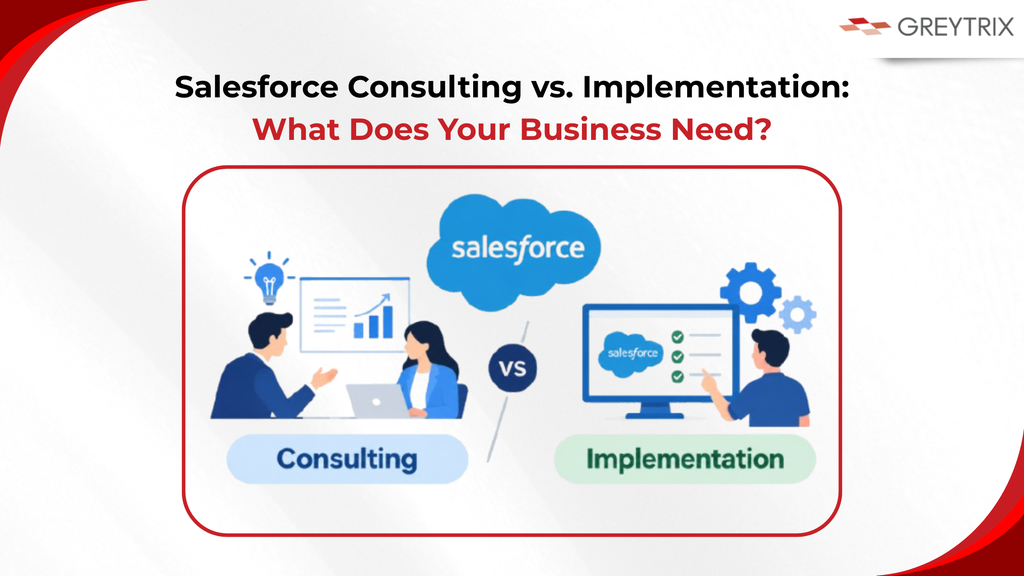
Salesforce is widely regarded as the world’s leading CRM, but getting value from it starts with one decision: does your organization need consultation or implementation?
Skipping this step often leads to confusion, scope creep, and rising costs without real growth.
The risk is well documented: McKinsey and Oxford’s analysis of more than 5,400 projects found that large IT projects run 45% over budget and 7% over schedule on average.
They also deliver 56% less value than predicted.
What is Salesforce Consulting?
Salesforce consulting is expert guidance on how to get the most from the Salesforce ecosystem. A Salesforce implementation consultant looks at your current processes, business needs, plans, and long-term goals, then recommends what to do, what to prioritize, and how to configure the platform to fit.
Without that guidance, organizations often overspend on features they don’t need or underuse the ones they do. Both cost money, and the time lost along the way cuts into revenue as well.
Salesforce Implementation
Implementation is the broader umbrella under which consultation falls. It covers the full journey of putting Salesforce to work, including planning the rollout, customizing the platform to fit your processes and needs, migrating important data from legacy systems, and training end users.
An experienced Salesforce implementation partner guides you through each of these stages, so nothing gets missed and your team is ready to use the platform without any confusion or lack of knowledge.
For a closer look at how this could work in practice, a free demo is a useful place to start.
Consulting vs implementation: key differences and how to choose
| Salesforce Consulting | Salesforce Implementation | |
| Scope | Strategy, process assessment, requirements, roadmap, and solution design. It is judgment-driven. | Configuration, customization, integrations, data migration, testing, training, and go-live. It is execution-driven, and starts once requirements exist, from your own team or a prior consulting phase. |
| Timeline | Usually short and front-loaded. Discovery and planning phases typically run 2-4 weeks. | Salesforce implementation pricing for Small business (out-of-the-box Sales Cloud): 4 to 8 weeks. Mid-market (multi-cloud, basic integrations): 8 to 16 weeks. Enterprise (complex workflows, ERP integration): 4 to 6 months. Large enterprise programs may take 9 to 18 months as well. |
| Cost | Typically billed by time. Around £3K–£15K per week | Typically billed per project. Around £50K–£300K+ per project. A small Sales Cloud setup can be Around £12,000–£35,000+ |
| Outcomes | A clear roadmap, aligned stakeholders, and defined scope. Consulting reduces implementation risk by making sure the build reflects real requirements. | A working, configured Salesforce org that is live, with migrated data and trained users. |
| Best for | Unclear goals, a first Salesforce purchase, or a major change. | Clear requirements, a chosen solution, and a team ready to build. |
Your project probably sits somewhere between these two columns. With 2.5+ decades behind us, Greytrix can help you pin down where, along with a realistic timeline and budget. Talk to our team.
Why Choosing the Right Starting Point Matters
Picture a business that wants a clearer view of its sales pipeline. The team jumps straight into building Salesforce, but they haven’t agreed on their sales stages, what reports they need, or how to handle new leads. Those questions come up halfway through the build. Even a small change, like adding one field or one report, can then grow the project, add more testing, and push back the delivery date.
When consulting is the right choice
Consulting gives your team time to settle these decisions before any building starts. Choose it if your processes, needs, or data are still unclear.
When implementation is the right choice
If your processes are agreed, your requirements are written down, and you know your data and integrations, go straight to building. Discussing settled decisions again only slows you down.
When you need both
Many businesses know their goal but still need help with a few things, such as checking their data, mapping integrations, or deciding what goes into the first release. A short consulting phase can cover this before the build begins.
The takeaway: Neither option is better on its own. The right choice depends on how ready your team is today.
A few Common pitfalls to avoid
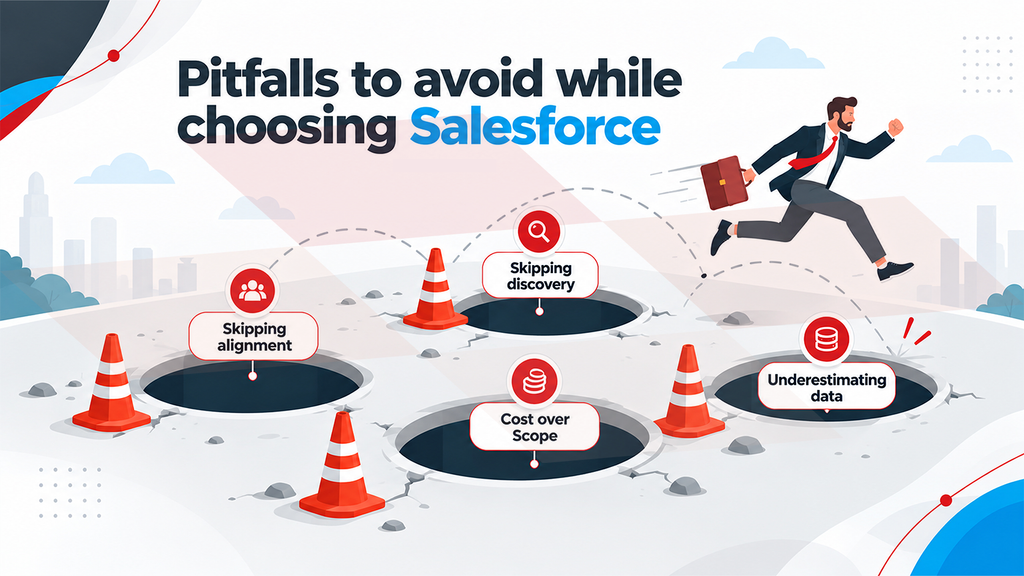
1) Skipping alignment on outcomes
When teams aren’t aligned on the “what,” progress slows and internal morale takes a hit. Sales wants pipeline visibility, service wants faster case resolution, and leadership wants cleaner reports, but no one has agreed which comes first. The result depends on where you start. Consulting turns into an endless workshop, with every stakeholder adding requirements and no one deciding. Implementation delivers a system that technically works but solves the wrong problem. Good Salesforce consulting partners help prevent both by pushing for clarity before work begins. Before any work begins, agree on two or three measurable outcomes, such as a shorter sales cycle or faster onboarding, and name one person who can settle disagreements. Clarity from day one reduces scope creep and speeds up every decision that follows.
2) Skipping discovery because of deadline pressure
Urgency makes teams jump straight to implementation to “show progress.” A launch date gets announced, leadership wants something visible, and building starts before anyone has mapped the processes, data, or integrations involved. The cost surfaces later as scope creep, rework, and budget overruns. A field that was never planned gets added after testing. An integration nobody mentioned turns out to be critical. Data that looked clean turns out to need weeks of work. A few weeks of consulting would have caught all of it. Discovery doesn’t have to slow you down either. Even a focused two to four week phase gives your build team a clear plan, so the time you spend upfront is usually less than the time you’d lose to fixing mistakes after go-live.
A short discovery phase with Greytrix can save you weeks of rework. Book your free spot.
3) Prioritizing cost over scope
Consulting may feel cheaper, but a lower rate doesn’t mean a lower total cost. A consultant can tell you what to build, yet you may still need delivery expertise to configure, migrate, and go live, and many budgets leave that cost out. The opposite mistake is just as expensive. Jumping into implementation without clear priorities can burn time and capital on features that never get used. Comparing quotes by day rate misses the real question: how much work does it take to reach your outcome? List what needs to get done, in what order, and who can deliver it. Then choose the engagement that covers that scope at a fair price.
4) Underestimating data work
Data is at the heart of a successful project, yet it’s often the part teams plan last. It isn’t just moving records from one system to another. It means mapping old fields to Salesforce fields, cleansing errors, removing duplicates, and validating the results with the people who use the data every day. Each step takes longer than expected, especially when records have built up over years across spreadsheets and legacy tools. Delaying this work puts your desired result at risk, whether you’re in a consulting phase or a full implementation. Consulting recommendations depend on data quality too, and a live system full of duplicates quickly loses people’s trust. Run a data audit early, so surprises show up in a week or two and not at go-live.
As certified Salesforce CRM Implementation partners, we at Greytrix help you get clear on outcomes, scope, and data readiness before you commit budget. Book a demo and we’ll help you pick the right starting point.
Integration: making Salesforce work with your existing systems
Implementation also means connecting Salesforce to the tools your teams already use, such as ERP, billing, marketing automation, and support platforms. Without those connections, teams re-enter data by hand and reports show only part of the customer picture. Decide early which systems need to talk to Salesforce, which data moves in each direction, and whether native connectors, APIs, or middleware fit best. Integrations add scope, so plan them during discovery, not during testing.
This is where GUMU™, our flagship product comes in. It can connect Salesforce across the Sage ecosystem, so customer, order, and invoice data stay in sync between your CRM and your ERP. It can also link Salesforce with your e-commerce store and WhatsApp, giving sales and service teams one view of every order and conversation.
Wrapping Up
Choosing between consulting and implementation comes down to one honest question: how clear are you on what you want to build?
Choose consulting if your goals are still fuzzy, stakeholders disagree on priorities, or this is your first Salesforce purchase. A few weeks of discovery gives you a roadmap and a realistic budget before you commit, and it costs far less than rebuilding the wrong thing later.
Choose implementation if your requirements are documented, the solution is agreed, and your team is ready to build. Adding more workshops at this stage only delays go-live and drains budget.
Choose both if you know the outcome you want but feel unsure about your data, integrations, or internal capacity. Start with a short assessment to close those gaps, then move straight into the build.
If data is what keeps you up at night, treat it as a first-phase priority. Messy records derail projects of either kind.
If you’re still undecided, that’s okay. Many teams start exactly here, and a discovery call can help you see the way forward.
With 10+ years of Salesforce experience and thousands of implementations, Greytrix has helped teams make this exact call. Book a demo, and let’s find right first step.
FAQs
1. What is the difference between Salesforce consulting and implementation?
Salesforce consulting focuses on strategy, business requirements, process assessment, and solution planning. Implementation focuses on configuring and customizing Salesforce, migrating data, integrating systems, testing the solution, and preparing users for launch.
2. Do I need Salesforce consulting before implementation?
Not always. If your requirements and priorities are already documented, you may be ready for implementation. If goals, workflows, data quality, or integration needs remain unclear, a discovery or consulting phase can help reduce rework.
3. How much does Salesforce implementation cost?
The cost depends on project scope, Salesforce products, customization, integrations, data migration, and training requirements. Obtain an estimate based on documented requirements and confirm which services and licensing costs are included.
4. How long does Salesforce implementation take?
The duration depends on complexity, the number of systems being integrated, data readiness, and stakeholder availability. A small, straightforward deployment may take weeks, while complex enterprise programs can take months or longer.
5. Can one partner handle both Salesforce consulting and implementation?
Yes. A partner can assess business needs, define the solution, implement it, and support adoption. Confirm that the proposed engagement includes both planning and delivery rather than assuming that a consulting scope covers the entire build.
6. When should a business consider Salesforce integration with its ERP?
Consider integration when teams need consistent customer, order, invoice, or other operational data across Salesforce and ERP systems. Define data ownership, synchronization requirements, and error-handling processes before choosing the integration approach.
About Us
Greytrix – a globally recognized and one of the oldest Sage Development Partner and a Salesforce Product development partner offers a wide variety of integration products and services to the end users as well as to the Partners and Sage PSG across the globe. We offer Consultation, Configuration, Training and support services in out-of-the-box functionality as well as customizations to incorporate custom business rules and functionalities that require apex code incorporation into the Salesforce platform.
Greytrix has some unique solutions for Cloud CRM such as Salesforce Sage integration for Sage X3, Sage 100 and Sage 300 (Sage Accpac). We also offer best-in-class Cloud CRM Salesforce customization and development services along with services such as Salesforce Data Migration, Integrated App development, Custom App development and Technical Support business partners and end users. Salesforce Cloud CRM integration offered by Greytrix works with Lightning web components and supports standard opportunity workflow. Greytrix GUMU™ integration for Sage ERP – Salesforce is a 5-star rated app listed on Salesforce AppExchange.
The GUMU™ Cloud framework by Greytrix forms the backbone of cloud integrations that are managed in real-time for processing and execution of application programs at the click of a button.
For more information on our Salesforce products and services, contact us at salesforce@greytrix.com. We will be glad to assist you.