
Businesses use a range of software solutions to manage their daily operations and streamline business processes. Each serves a specific purpose whether it is to optimise resources or increase output. Identifying ways to save time and improve efficiency remains a key business priority. Inventory management and sales are two key areas where businesses can save considerable time.
While these solutions work well individually, the right integration can make them even more effective.
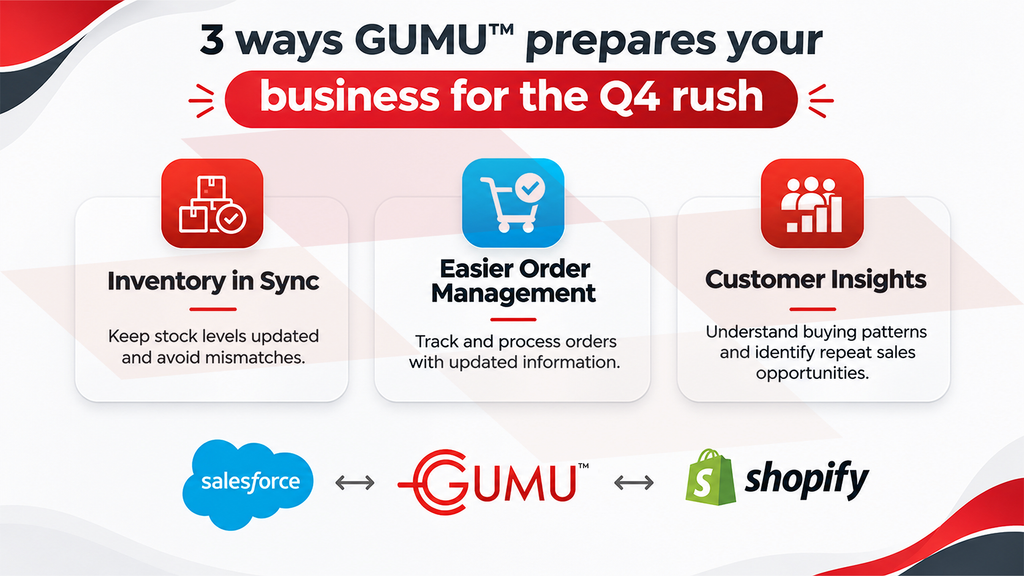
This becomes especially important in Q4, when events like Black Friday, Cyber Monday and Christmas bring more orders, higher customer demand and added pressure on teams.
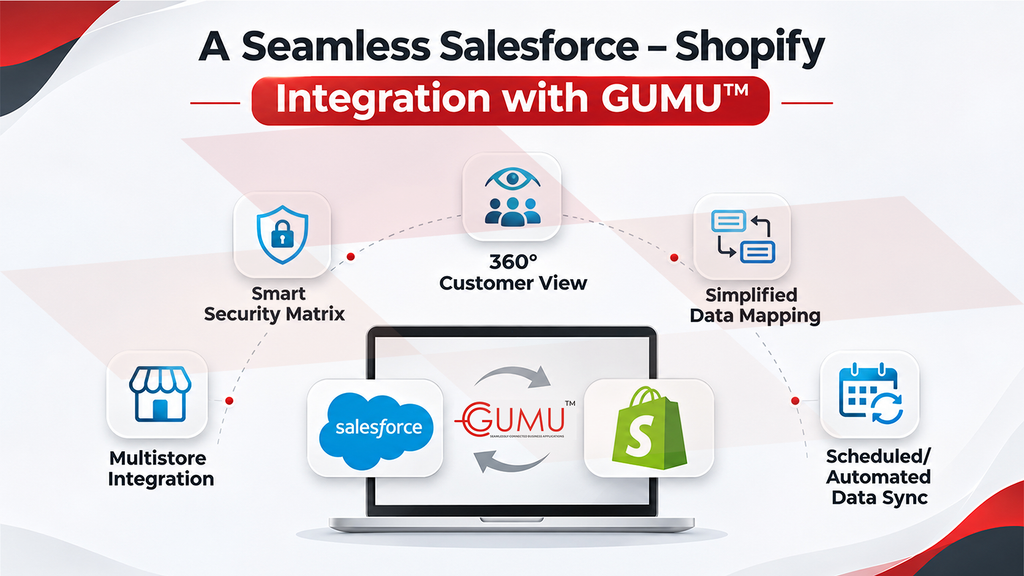
GUMU™ helps businesses connect Shopify and Salesforce, giving them clear inventory visibility and a complete picture of sales without manual data entry. This Shopify Salesforce integration also offers a 360° customer view, multi-store and multi-region management, and bi-directional data sync.
What is Salesforce Shopify Integration?
Salesforce Shopify Integration connects your Shopify (Ecommerce store) with Salesforce (CRM), keeping customer and order data in sync. It reduces manual data entry and gives your teams a clear view of customer information, sales and operations.
Introducing GUMU™ Integration for Salesforce Shopify
GUMU™ is a Web API framework available as a single-click SaaS platform. It comes with out-of-the-box data mapping capabilities, making application integration and data migration easier.
For Salesforce integration with Shopify, GUMU™ offers a simple way to connect both platforms. Its bi-directional data sync keeps information updated between Salesforce and Shopify. This includes customer details, orders, inventory and more. With simplified data mapping, teams can map fields between the two platforms without writing any code. It also provides a 360-degree, real-time view of sales and service data, helping teams keep track of customer interactions across both systems.
GUMU™ also takes care of data security. Teams can assign user roles and set access levels from a central dashboard, ensuring that sensitive information is accessible only to authorized users.
Why It Matters for Inventory Management and Sales
Disconnected systems can lead to stock mismatches, missed sales opportunities and gaps in customer information. Salesforce Shopify Integration keeps inventory, order and customer data connected, helping teams manage operations and make better business decisions.
With GUMU™ No more…
- Manually updating orders, customer details, inventory, and products in both platforms.
- Switching between platforms to find customer details, purchase history and order activity.
- Having a dependency on developers to set up or change data mapping between both platforms.
- Manually tracking every data change or worry about who has accessed it.
- Sorting customer data or create separate lists for marketing campaigns.
- Managing each Shopify store and its data separately.
GUMU™ Shopify Salesforce integration use case in Inventory management
1. Manual Stock Updates
Keeping stock levels updated on both platforms can take time. Manual updates also increase the chances of errors.
- Without: Teams manually update stock levels in both platforms.
- With: Stock information stays updated across Shopify and Salesforce.
2. Stock Mismatches
Accurate stock information is important for managing product availability. Different stock records can make it difficult to know what is available.
- Without: Different stock records can lead to incorrect product availability.
- With: With GUMU™ Teams work with consistent inventory information across both platforms.
3. Overstocking and Understocking
Maintaining the right stock levels is important for any business. Poor visibility into inventory can make purchase and restocking decisions difficult.
- Without: Teams struggle to make restocking decisions with scattered inventory data.
- With: Updated stock information helps teams plan purchases and restocking.
4. Difficulty Tracking Products
Businesses need easy access to product details and stock availability. Switching between platforms to find this information can slow down daily work.
- Without: Teams switch between platforms to check product details and availability.
- With: Product and inventory information is accessible through connected systems.
5. Order Fulfilment Delays
Processing orders on time depends on knowing which products are in stock. Outdated inventory information can lead to delays in order fulfilment.
- Without: Outdated stock information can cause delays in processing and fulfilling orders.
- With: Updated inventory data helps teams check product availability before processing orders.
6. Limited Inventory Insights
Understanding stock levels and product demand helps businesses plan inventory. When information is spread across platforms, getting a clear picture becomes difficult.
- Without: Teams gather data from different platforms to understand stock levels and product demand.
- With: Connected data gives teams better inventory visibility and helps them make informed decisions.
GUMU™ Shopify Salesforce integration use case in Sales Tracking
1. Manual Order Tracking
Tracking orders across two platforms can take time when information is not connected. This makes it harder for teams to keep track of sales activity.
- Without: Teams manually check orders across Shopify and Salesforce to track sales activity.
- With: Order information stays updated across both platforms.
2. Scattered Customer Information
Customer details and purchase history may be spread across different platforms. This makes it difficult for sales teams to find the information they need.
- Without: Sales teams switch between platforms to find customer details and purchase history.
- With: Customer information and purchase history are available in Salesforce.
3. Difficulty Tracking Sales Performance
Understanding sales performance requires access to accurate order and sales data. When this data is spread across platforms, tracking performance takes more time.
- Without: Teams spend time gathering sales data from different platforms to understand performance.
- With: Connected sales data gives teams a clearer view of orders and sales activity.
4. Missed Sales Opportunities
Past purchases can help businesses identify customers who may buy again. Without easy access to this information, some sales opportunities may go unnoticed.
- Without: Teams may miss repeat purchase opportunities because customer buying patterns are difficult to track.
- With: Access to purchase history helps teams identify customers who may be interested in buying again.
5. Delayed Customer Follow-ups
Timely follow-ups depend on having the latest customer and order details. When this information is not readily available, responding to customers can take longer.
- Without: Sales teams may not have the latest order and customer information when following up with customers.
- With: Updated customer and order details help teams make timely and relevant follow-ups.
6. Limited Sales Insights
Customer preferences and buying trends offer useful insights for sales teams. However, these patterns can be difficult to identify when data is spread across platforms.
- Without: Teams struggle to identify popular products, buying trends and customer preferences across platforms.
- With: Connected customer and order data helps teams understand buying patterns and make informed sales decisions.
Conclusion
Salesforce Shopify Integration is more than just a useful addition for businesses using both platforms. It helps reduce manual work, keeps business data connected and gives teams more time to focus on sales and customer service.
With features such as bi-directional data sync, pre-built data mapping, automated workflows, and role-based access controls, GUMU™ makes it easier to manage data across Shopify and Salesforce.
As Q4 approaches, these capabilities can help your teams manage rising order volumes, keep track of inventory and make better use of customer data during peak shopping events.
Greytrix continues to support you even after your Shopify and Salesforce integration goes live. Our dedicated support team assists with updates, changes, troubleshooting and ongoing requirements. Whether you need help resolving an issue or adapting the integration to changing business needs, we are here to help.
To experience how GUMU™ would fit your business needs, book a demo today.
Frequently Asked Questions
The integration can take anywhere from a few days to a few weeks, depending on the project scope, data requirements and level of customization.
Yes. GUMU™ supports multi-store integration, allowing businesses to connect multiple Shopify storefronts with Salesforce and manage their data across platforms.
Yes — and GUMU™ handles it automatically.
Every Shopify order appears in Salesforce with full context: customer info, payments, fulfilment details, and history.
Your sales, service, and marketing teams get a complete view without hunting for data or manually updating sheets.
Yes. The Greytrix team will continue to support you even after go-live. We help with ongoing maintenance, troubleshooting, updates and any integration-related issues to keep your Shopify and Salesforce systems running smoothly.
Yes. GUMU™ provides role-based access controls, allowing businesses to assign user roles and permissions from a central dashboard. This helps ensure that only authorized users can access business data.
About Us:
Greytrix – a globally recognized and one of the oldest Sage Development Partners is a one-stop solution provider for Sage ERP and Sage CRM organizational needs. Being acknowledged and rewarded for multi-man years of experience and expertise, we bring complete end-to-end assistance for your technical consultations, product customizations, data migration, system integrations, third-party add-on development, and implementation competence.
The unique GUMU™ integration solutions provided by Greytrix for Sage 100 include Sage 100 integration with Sage CRM, and Salesforce.com, Dynamics 365 CRM, the migration solutions include Sage 100 Migration from Sage 50 US, Sage Intacct, QuickBooks, Sage Business Vision and Sage Business Works. We also offer best-in-class Sage 100 customization and development services to Sage business partners, end users, and Sage PSG worldwide. Sage 100 product listings by Greytrix include Salesforce – Sage ERP integration available on Salesforce Appexchange, Dynamics 365 CRM – Sage ERP integration available on Microsoft Appsource (Free Trial).
The GUMU™ Cloud framework by Greytrix forms the backbone of cloud integrations that are managed in real-time for processing and execution of application programs at the click of a button.
For more details on Sage 100 Services, please contact us at sage@greytrix.com. We will like to hear from you.