
Implementation is not the end of the Salesforce journey. Businesses continue to adapt and change the environment as per their preferences. As these changes grow, managing updates, troubleshooting issues, maintaining integrations, supporting users, and more can become an ongoing challenge. In fact, around 65% of CRM projects underperform due to low user adoption — a gap that only widens without continued support. Managed services Salesforce programs help firms handle these ongoing needs even after go-live, bringing structured, Salesforce-specific expertise to a phase business often underestimate.
What Typically Goes Wrong After Go-Live?
Once implementation wraps, the dedicated project team moves on — but the org still needs attention. User adoption often drops as people drift back to old habits. Data quality slips without ongoing governance. New Salesforce releases can quietly break existing customizations. And routine admin requests pile up with no clear owner. Individually these look-like small issues, but left unattended they compound — which is usually the point where businesses realize they need structured, ongoing support rather than ad hoc fixes.
What Is Salesforce Managed Services?
Salesforce managed services are offered by certified consulting firms with deep, hands-on experience across the Salesforce ecosystem. A Salesforce managed service provider brings certified admins, developers, and architects who understand how businesses actually use the platform day to day. Many also handle end-to-end Salesforce implementation, giving them a head start once you move into the post-go-live phase, since they already know the org inside out.
Greytrix is a Salesforce managed services partner with 25+ years of CRM and ERP consulting experience. Choosing the right partner means looking beyond basic support — you want a team that can proactively optimize your environment and help you scale as your needs evolve.
Who Provides Salesforce Managed Services?
| In-House Admin | Independent Consultant | Managed Services Team | |
| Coverage | Business hours only | Limited to one person’s bandwidth | Round-the-clock, multiple specialists |
| Skill range | Admin-focused | Deep but narrow (their specialty) | Admin + dev + architecture combined |
| Scales with growth | Limited | Limited | Built to scale |
These types of ongoing support services are typically delivered by consulting firms and independent experts who stay current with every Salesforce release, security update, and platform capability. A skilled Salesforce implementation consultant who transitions into an ongoing support role can be just as valuable as a dedicated managed services team, since they already understand your business processes, data model, and customizations.
That said, businesses increasingly look to specialized firms rather than individual consultants, because a full team can cover admin work, development, integrations, and strategic planning at once — something a single consultant working alone typically cannot sustain long-term.
What Do Salesforce Managed Services Providers Do?
Salesforce managed services providers are specialized teams that help businesses manage and maintain their Salesforce environment after implementation. Their role goes beyond fixing issues; they continuously monitor the system, manage Salesforce releases (Summer, Winter, Spring), handle integrations, provide user support, and make necessary customizations. By taking care of these ongoing technical and operational needs, managed service providers help businesses keep their Salesforce environment aligned with changing business requirements.
Key Areas Covered by Salesforce Managed Services
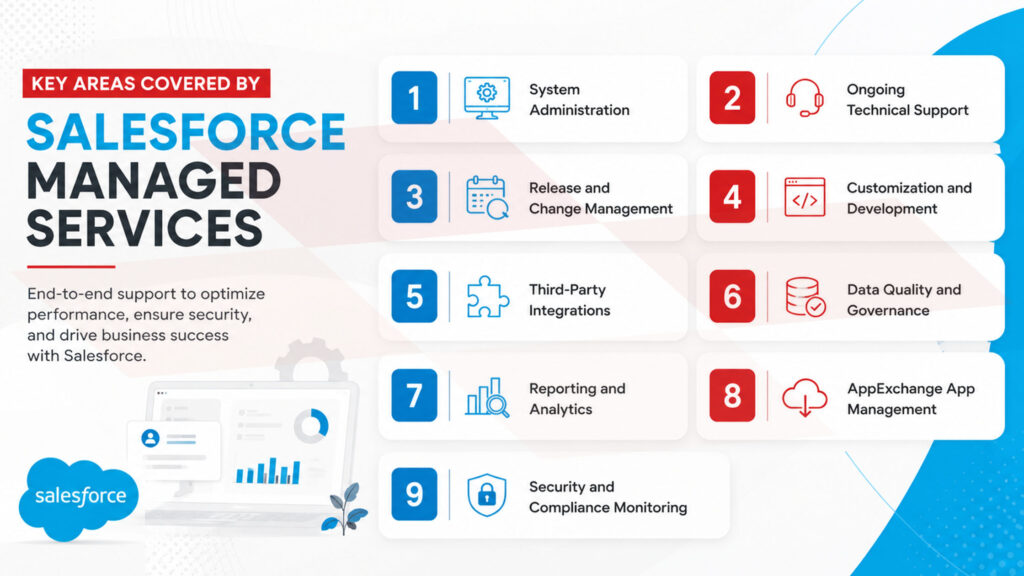
Understanding what falls under the scope of managed services helps businesses know exactly what to expect from a partnership. Here’s a breakdown of the key areas:
1. System Administration Day-to-day admin work — user management, role and permission updates, workflow and flow maintenance, and security settings — keeps the org running smoothly. Managed services teams handle these routine tasks so internal staff can focus on higher-value initiatives instead of getting buried in configuration requests.
2. Ongoing Technical Support Issues don’t stick to business hours. Managed services providers typically offer round-the-clock or extended-hours support to resolve system errors, login problems, integration failures, and other disruptions before they affect productivity.
3. Release and Change Management Salesforce ships three major releases a year, each bringing new features, deprecated functionality, and potential impacts on existing customizations. Service teams test these releases in a sandbox, flags anything that could break, and rolls out updates without disrupting daily operations.
4. Customization and Development Business needs shift, and so should the Salesforce org. Managed services teams use Apex, Visualforce, Lightning Web Components (LWC), and Flow to build new features, refine existing ones, and keep customizations aligned with how the business actually operates.
5. Third-Party Integrations Most Salesforce orgs connect to other systems — ERPs, marketing platforms, finance tools, and more. Managed services providers monitor these integrations, fix broken data flows, and update connections as APIs and endpoints evolve on either side.
Purpose-built connectors make this easier to sustain. Greytrix’s GUMU™ integrator, for example, links Salesforce with ERPs like Sage X3, Sage 100, Sage 300, and Acumatica through two-way sync, giving sales and finance teams accurate order and invoice data without leaving Salesforce. Managed services teams keep such connectors configured correctly and adjust them as data structures on either side change.
6. Data Quality and Governance Clean, reliable data is the foundation of good decision-making. Ongoing deduplication, validation rules, and data hygiene routines prevent the clutter that quietly erodes CRM value over time.
7. Reporting and Analytics Managed services teams build and refine dashboards and reports so leadership always has visibility into what’s working and what isn’t, based on real usage patterns rather than assumptions.
8. AppExchange App Management From evaluating new apps to configuring and maintaining installed packages, managed services providers help extend platform capabilities without introducing unnecessary complexity or licensing costs.
9. Security and Compliance Monitoring Regular audits of access controls, login history, and permission sets help catch vulnerabilities early and keep the org compliant with industry-specific regulations.
Best Practices for Getting the Most Out of Salesforce Managed Services
1. Set Clear Expectations from Day One Define response times, escalation paths, and the scope of work in a formal SLA. Ambiguity around what’s covered is one of the most common sources of friction between businesses and their support partner.
2. Choose a Partner with Proven Experience
Not every provider is equal. Look at case studies, client retention, and certifications before signing on. Comparing a few of the top Salesforce implementation partners that also offer managed services can help you evaluate who has the depth to support you long after go-live, not just during the initial rollout.
3. Keep a Continuous Feedback Loop with Users Regular surveys and check-ins with end users surface friction points early. Your support partner can only fix what it knows about, so building a habit of collecting feedback matters as much as the technical work itself.
4. Prioritize Scalable Customizations Every new feature or workflow should be built with growth in mind. Customizations that solve today’s problem but ignore tomorrow’s scale tend to require expensive rework down the line.
5. Stay Ahead of Salesforce Releases Rather than reacting to changes after they go live, review release notes early, test in a sandbox, and plan rollouts around your business calendar to avoid disruption during critical periods.
6. Don’t Treat Security as a One-Time Setup Access reviews, audit trails, and multi-factor authentication checks should happen on a regular schedule, not just during implementation or after an incident.
About Greytrix
Greytrix is a certified Salesforce implementation consultant and services partner with 25+ years of experience, having served clients across the globe. Beyond implementation, we handle the full lifecycle of a Salesforce environment — customization, integration, data migration, and ongoing managed services — so businesses don’t have to switch partners once they go live. Our GUMU™ platform also connects Salesforce with ERPs like Sage Intacct, Sage X3, Sage 100, Sage 300, and Acumatica, making us a natural fit for organizations that need Salesforce working in sync with the rest of their business systems long after implementation ends.
Conclusion
Salesforce optimization doesn’t stop at go-live — it’s an ongoing process that determines how much value a business actually gets from its investment. Partnering with the right team for managed services Salesforce support ensures system performance, user adoption, and platform capabilities keep pace with your evolving needs, rather than slowly falling behind.
Ready to get more out of your Salesforce investment? Book a demo and let’s talk through where your environment stands today.
Frequently Asked Questions (FAQs)
1. How much do Salesforce managed services cost?
Salesforce managed services pricing typically ranges from $1,500 to $10,000+ per month depending on the scope — number of users, integrations, customization needs, and the level of support required. Most Salesforce managed service providers offer tiered retainer packages, so businesses pay for only the capacity they need. Getting a scoped proposal from two or three providers is the best way to benchmark what’s reasonable for your org size.
2. What is the difference between Salesforce implementation and Salesforce managed services?
Salesforce implementation refers to the one-time process of configuring, customizing, and deploying the platform to fit your business processes. Managed services Salesforce programs pick up where implementation ends — covering ongoing administration, updates, user support, and continuous optimization after go-live. Many businesses work with the same Salesforce implementation consultant or firm for both, since they already understand the org’s data model and customizations.
3. When should a business switch from an in-house admin to a Salesforce managed services team?
The clearest signals are when your admin is regularly backlogged, when Salesforce releases are going untested, or when integration failures are going unnoticed until they cause data problems. A Salesforce managed services partner makes sense when the platform has grown complex enough that a single person can no longer cover admin work, development, and strategic planning simultaneously. Most businesses make the switch between 50 and 200 users, or when a second major integration is added.
4. Can a Salesforce managed services partner help with third-party integrations?
Yes — managing and maintaining integrations is one of the core responsibilities of a Salesforce managed service provider. This includes monitoring data syncs, updating API connections when endpoints change, and troubleshooting broken flows between Salesforce and tools like ERPs, marketing platforms, or finance systems. Businesses evaluating a few of the top Salesforce implementation partners should also check whether that partner offers post-go-live support — since integrations typically need ongoing attention long after go-live.
About Us
Greytrix – a globally recognized and one of the oldest Sage Development Partner and a Salesforce Product development partner offers a wide variety of integration products and services to the end users as well as to the Partners and Sage PSG across the globe. We offer Consultation, Configuration, Training and support services in out-of-the-box functionality as well as customizations to incorporate custom business rules and functionalities that require apex code incorporation into the Salesforce platform.
Greytrix has some unique solutions for Cloud CRM such as Salesforce Sage integration for Sage X3, Sage 100 and Sage 300 (Sage Accpac). We also offer best-in-class Cloud CRM Salesforce customization and development services along with services such as Salesforce Data Migration, Integrated App development, Custom App development and Technical Support business partners and end users. Salesforce Cloud CRM integration offered by Greytrix works with Lightning web components and supports standard opportunity workflow. Greytrix GUMU™ integration for Sage ERP – Salesforce is a 5-star rated app listed on Salesforce AppExchange.
The GUMU™ Cloud framework by Greytrix forms the backbone of cloud integrations that are managed in real-time for processing and execution of application programs at the click of a button.
For more information on our Salesforce products and services, contact us at salesforce@greytrix.com. We will be glad to assist you.