

Beyond Material Planning: Why Modern Manufacturers Are Pairing MRP with Real-Time APS
Material Requirements Planning (MRP) has been the backbone of manufacturing ERP for decades. But as production environments become more dynamic, planning materials alone is no longer enough. McKinsey found that while 76% of companies have implemented Advanced Planning & Scheduling (APS), 41% still require too many manual interventions because their planning processes aren’t fully optimized. This is where pairing MRP with real-time APS becomes critical.
Legacy MRP tells you what to build. It doesn’t tell you whether your work centres, labor, and machine capacity can actually build it on that timeline — and in a modern production environment, that gap is where plans quietly fall apart.
As an Acumatica partner working inside manufacturing environments day to day, Greytrix sees this gap close reliably in one specific way: running MRP and Advanced Planning and Scheduling (APS) as a connected pair on a single cloud platform, configured against how a plant actually operates — not treating scheduling as a bolt-on module or a spreadsheet exercise layered on top of a planning output.
MRP: The Planning Engine
Acumatica’s MRP calculates material and production requirements by exploding demand — sales orders, forecasts, and safety stock rules — down through multi-level bills of material, generating recommended purchase orders and production orders automatically. It runs against real, live inventory and open-order data rather than a periodic snapshot, which matters more than it sounds: a nightly-batch MRP run is already stale by the time a shop floor supervisor acts on it.
| Acumatica MRP Capability | What It Helps Manufacturers Do |
| Forecast and demand planning | Plan supply against forecasts and actual customer demand |
| Material requirements planning | Identify what materials need to be purchased or produced |
| Planned production orders | Generate production recommendations based on requirements |
| Purchase recommendations | Plan purchased materials based on demand and lead times |
| Exception messages | Identify orders that may need to be expedited, deferred, deleted, or reviewed |
| Multi-warehouse planning | Coordinate inventory, production, procurement, and transfers across locations |
APS: The Capacity Reality Check
This is where Acumatica separates from MRP-only systems. Advanced Planning and Scheduling takes MRP’s output and schedules it against actual, finite capacity — specific work centres, machine availability, labor shifts, and setup/changeover times — rather than assuming infinite capacity exists whenever a plan says something is needed.
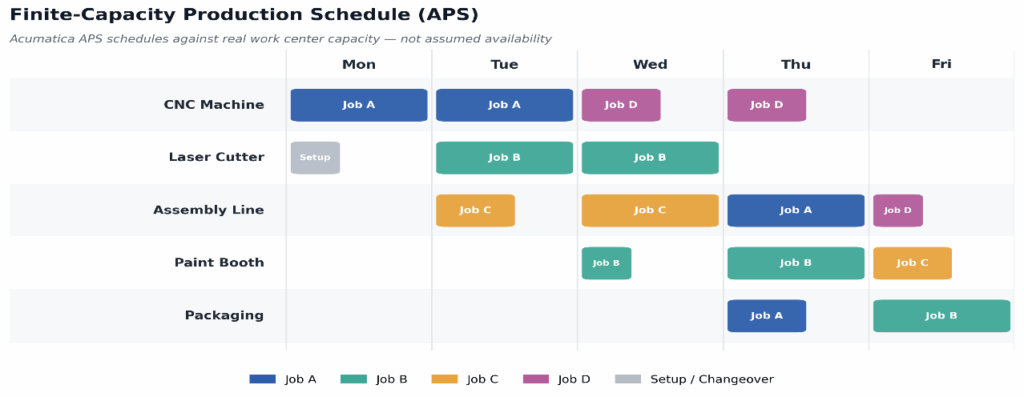
The practical difference: MRP alone can generate a plan that’s mathematically correct and operationally impossible — recommending a production order for Tuesday that no work centre actually has open capacity for. APS is what catches that before it becomes a missed ship date instead of after. Greytrix configures APS against a plant’s real work centre definitions and shift patterns during implementation, so that catch happens correctly from week one rather than being calibrated through trial and error after go-live.
| Comparison Point | Legacy MRP-Only / Bolted-On APS | Acumatica MRP + APS |
| Data currency | Batch/nightly sync between systems | Real-time, single data model |
| Capacity awareness | Often absent or manual | Built-in finite capacity scheduling |
| Rescheduling speed | Manual re-run, hours to days | Immediate, automatic recalculation |
| Access | Fixed workstation, on-prem client | Any device, cloud-native |
| Licensing model | Per-user, often per-module | Unlimited users, consumption-based |
Why the Pairing Matters More on a Cloud Platform
Legacy ERPs that offer both MRP and APS typically run them as separate modules, often from different vendors, stitched together with exports and imports. Data moves between them in batches, which means the schedule a planner is looking at is only as current as the last sync. Acumatica runs both natively on the same cloud data model, so a change anywhere in the system — a new sales order, a delayed shipment, a machine going down — updates both material requirements and the production schedule in real time, visible from any device, on the shop floor or off it. MRP-generated orders are initially scheduled using infinite capacity, and finite scheduling is then performed through APS/RCCP processes.
For a growing manufacturer, that unlimited-user model matters as much as the technical architecture — shop floor supervisors, purchasing, and planners all see the same live schedule without a license fee gating who gets access to it.
Greytrix Implementation: Where the Platform Becomes Trustworthy
MRP and APS are only as good as the data and rules configured underneath them — lead times, BOM accuracy, work centre capacity definitions, and safety stock logic all have to reflect how a plant actually operates, not a generic template. Get the setup wrong and APS will schedule confidently against numbers that don’t hold up on the floor. This is the gap between a manufacturer owning Acumatica’s license and a manufacturer actually running on it.
Greytrix’s implementation process is built around closing exactly that gap:
- Requirement mapping against real plant operations — not a generic manufacturing template, but the specific work centres, shift patterns, and product lines a plant actually runs.
- Module configuration tuned to real data — MRP safety stock rules, reorder logic, and APS capacity constraints set against a plant’s actual lead times and throughput, not defaults.
- Controlled data migration — historical BOM, routing, and inventory data brought in clean, with legacy errors caught and corrected rather than carried forward into the new system.
- Post-go-live tuning — scheduling and planning rules refined against real production results in the weeks after launch, not left as a one-time setup.
The platform gives a manufacturer the planning and scheduling engine. Greytrix’s implementation is what makes that engine trustworthy enough for a planner to act on without double-checking it by hand — and it’s the difference most manufacturers actually notice in year one.
Ready to Put MRP and APS to Work on Your Floor?
If your current planning process still means exporting an MRP run into a spreadsheet to figure out whether the shop floor can actually hit it, that’s the exact gap a properly configured Acumatica implementation is built to close. As an Acumatica partner, Greytrix’s job is making sure that configuration reflects your plant on day one — not a generic template you spend a year correcting.
Talk to a Greytrix ERP Consultant →
Frequently Asked Questions
MRP calculates what to build and how much material is needed, assuming unlimited capacity. APS schedules that output against real work centre, machine, and shift constraints. Greytrix configures both to reflect your plant’s actual constraints.
APS runs natively on MRP output inside Acumatica’s single cloud data model — no separate import step. Accuracy depends on the work centre and capacity data configured behind it, which Greytrix sets up during implementation.
Yes — Acumatica supports multi-warehouse planning natively across locations. Greytrix maps each plant’s work centres and capacity individually so scheduling isn’t one-size-fits-all.
Timelines vary by plant complexity and existing data quality, starting with requirement mapping against real operations. Talk to a Greytrix consultant for a timeline scoped to your plant.
Acumatica recalculates the schedule immediately, with no manual re-run needed. Planners see the updated, feasible schedule right away instead of finding out from the floor.
It’s built for growing manufacturers — unlimited-user, consumption-based licensing means teams share one live schedule without per-seat costs. Greytrix scopes implementations sized to the plant, not enterprise assumptions.
About Us:
Greytrix has a wide product range for Acumatica. A Cloud ERP with unique GUMU™ integrations include Acumatica for Shopify | Magento | Dynamics 365 CRM.
The GUMU™ Cloud framework by Greytrix forms the backbone of cloud integrations that are managed in real-time for the processing and execution of application programs at the click of a button.
We also offer best-in-class Acumatica Development Services, Consulting Services for Acumatica to Acumatica business partners, resellers, and Acumatica VARs worldwide. Greytrix constantly develops apps, products, and add-ons to enhance user experience.
For more information on Acumatica Cloud Services, please contact us at acumatica@greytrix.com. We will like to hear from you.