Salesforce Flow Fault Paths: How to Handle Errors, Log Failures, and Prevent Flow Errors [In-Progress]

If you’ve built Flows for any length of time, you’ve probably had this morning. You open your inbox and there it is: an email with the subject line “Error Occurred During Flow” and a wall of text underneath it. Meanwhile, a sales rep is messaging you because they clicked Save and got a scary red… Read More: Salesforce Flow Fault Paths: How to Handle Errors, Log Failures,… »

Salesforce Profiles vs Permission Sets: Key Differences, Examples, and Best Practices

Managing user access is one of the most important parts of Salesforce administration. As an organization grows, different users need different levels of access to objects, fields, records, applications, and Salesforce features. Two key tools used to manage this access are Profiles and Permission Sets. Although both control what users can do in Salesforce, they… Read More: Salesforce Profiles vs Permission Sets: Key Differences, Examples, and Best… »

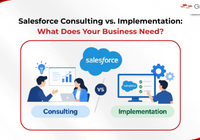
Salesforce Consulting vs. Implementation: What Does Your Business Need?

Salesforce is widely regarded as the world’s leading CRM, but getting value from it starts with one decision: does your organization need consultation or implementation? Skipping this step often leads to confusion, scope creep, and rising costs without real growth. The risk is well documented: McKinsey and Oxford’s analysis of more than 5,400 projects found… Read More: Salesforce Consulting vs. Implementation: What Does Your Business Need? »

How Salesforce Helps Professional Services Firms Improve Utilization Tracking

For professional services firms, effective resource utilization directly impacts revenue and project profitability. Too much unallocated time can result in lost revenue, while over-allocation can place unnecessary pressure on teams. Inconsistent tracking of billable and non-billable hours can further make it difficult to understand how effectively resources are being used, putting project margins at risk.… Read More: How Salesforce Helps Professional Services Firms Improve Utilization Tracking »

Salesforce Winter ’26 Release: Key Features Every Salesforce Admin Should Know

Every new Salesforce release brings a fresh wave of updates, and Winter ’26 is no exception. While this release does not lead with flashy headline features, it quietly delivers something more valuable to admins: practical, everyday improvements that remove friction from the tools they use constantly. Salesforce ships a new release three times a year,… Read More: Salesforce Winter ’26 Release: Key Features Every Salesforce Admin Should… »

Salesforce LWC Performance Optimization: Common Issues and How to Fix Them

Lightning Web Components (LWC) are designed to provide a fast and responsive user experience. However, poorly optimized components can become slow, especially when working with large datasets, Apex, or complex UI. Here are some of the most common LWC performance issues and how to fix them. Too Many Apex Calls One of the most common… Read More: Salesforce LWC Performance Optimization: Common Issues and How to Fix… »

SOQL vs SOSL in Salesforce: Key Differences and Real-World Use Cases

Salesforce provides powerful ways to retrieve and search data, with SOQL (Salesforce Object Query Language) and SOSL (Salesforce Object Search Language) being two of the most commonly used options. Although both are used to find Salesforce data, they serve different purposes. A simple way to remember the difference is: SOQL is used to query specific… Read More: SOQL vs SOSL in Salesforce: Key Differences and Real-World Use… »

Salesforce Managed Services: What Happens After Implementation

Implementation is not the end of the Salesforce journey. Businesses continue to adapt and change the environment as per their preferences. As these changes grow, managing updates, troubleshooting issues, maintaining integrations, supporting users, and more can become an ongoing challenge. In fact, around 65% of CRM projects underperform due to low user adoption — a… Read More: Salesforce Managed Services: What Happens After Implementation »

Apex Cursors vs. Batch Apex: Which Salesforce Data Processing Approach Should You Use?

Processing large volumes of records is a common requirement in Salesforce. Traditionally, Batch Apex has been the preferred approach for processing large datasets asynchronously. With the introduction of Apex Cursors, developers now have another option for working with large SOQL result sets. Apex Cursors became generally available in Spring ’26 (API version 66.0) and provide… Read More: Apex Cursors vs. Batch Apex: Which Salesforce Data Processing Approach… »