
Mid-market growth rarely arrives as a single event. Every new warehouse, location or business unit adds another layer of operational complexity: more handoffs, more reconciliation, and greater demands on inventory visibility and financial reporting.
Multi-location growth raises the questions that matter most. Can every site see the same inventory and financials? Can a new location be added without a six-month project? Can leadership see margin by site, not only in total? Acumatica and NetSuite are both capable cloud platforms. This briefing compares how each handles that complexity, so the board can choose the one that fits where the business is heading.
Which ERP Is Best for a Growing Mid-Market Business? The Short Answer
- Choose Acumatica if your headcount is growing or your user base is broad (many occasional users across departments), if you want deployment flexibility, or if you run distribution, manufacturing or construction operations where industry depth matters.
- Choose NetSuite if you want a single, cloud-only suite on Oracle’s infrastructure, run a smaller and finance-heavy user group, and value a very broad horizontal module library.
- Either way, the partner who implements and supports the system will shape your outcome as much as the platform does.
The rest of this article shows how to reach that conclusion for your own business.
Which Scenario Are You Really In?
You are adding locations, warehouses or legal entities
Each new site multiplies complexity: inventory in more places, transfers between them, consolidated reporting across entities. Test how each platform handles your next three locations, not only your current one. If you also need deployment flexibility or depth in distribution, manufacturing or construction workflows, shortlist Acumatica.
Your workflows are specialised
Complex inventory, project costing or production workflows decide more than feature counts do. Prove them in a scripted demo on your own orders, items and locations. Test both platforms against the same scripts before the board decides.
Governance and deployment requirements dominate
If security, data residency or internal policy call for a private cloud, only Acumatica offers that option of the two. If a single cloud-only platform is a feature, not a constraint, NetSuite stays on the list.
The statement quoted below are composites of what boards of growing businesses commonly say. They are illustrative, not attributed to any client.
Acumatica: Supporting Growth Across Multiple Locations and Complex Operations
What the board hears: “Every new location turns into another project.”
Verdict: Acumatica. When growth comes through new locations, channels and specialised workflows, the cost is complexity: each addition becomes its own project. Acumatica is a cloud ERP with distribution, manufacturing and construction capabilities, designed to connect, so more of the business can work in one system as it expands.
What the board gets. Distribution and financials on one platform across sites, open APIs for channel and system connections, and the choice of public cloud, private cloud or perpetual licensing. Greytrix’s GUMU™ platform connects Acumatica with e-commerce, CRM, POS and payment gateways. [CONFIRM: current GUMU connector list for Acumatica]
What to pressure-test. Flexibility rewards clear requirements. Plan customization and multi-location rollout against business outcomes, and confirm that the licensing scope matches how you expect to use the system.
NetSuite: Understanding Its Standardised Cloud Approach
What the board hears: “We want one standard platform, run by someone else, across every location.”
Verdict: NetSuite. When the priority is one standardised platform across locations, run in a single cloud environment by the vendor, NetSuite removes hosting decisions and offers broad horizontal coverage across industries.
What the board gets. One cloud-only environment, a wide module library and a consistent operating model across sites. [CONFIRM: NetSuite strengths against NetSuite’s current public pages]
What to pressure-test. A cloud-only model leaves no private-cloud option, and specialised distribution, manufacturing or construction workflows should be proven early in a scripted demo. Confirm how licensing scales as you add users and locations.
1. Pricing and licensing: the decision that compounds
This is the most structural difference between the two platforms.
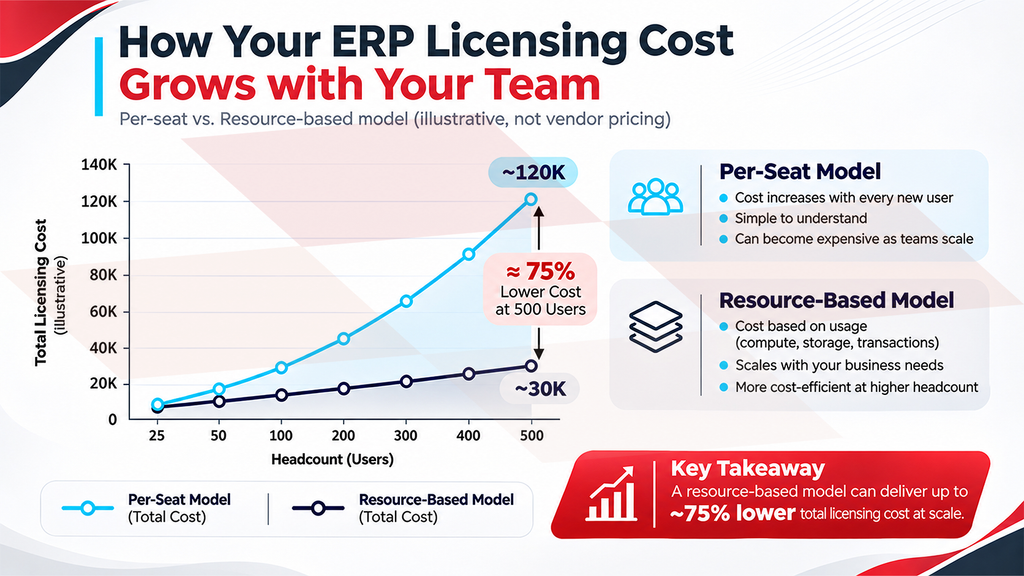
NetSuite is licensed as an annual subscription: a base platform, plus modules, plus a fee for each user. Every new seat adds cost. That makes budgeting predictable, and it suits a stable, compact team.
Acumatica takes a different approach. It prices on the applications you license and a resource and transaction-volume tier, with unlimited users. Adding a salesperson, a warehouse lead or a regional manager does not add a license line.
For the boardroom, the practical question is the shape of your growth:
| Your growth pattern | Likely better fit |
| Headcount growing faster than transactions | Acumatica |
| Many occasional or cross-department users | Acumatica |
| Small, finance-heavy team with high transaction volume | Worth modelling both |
| Need for fixed per-seat budgeting | NetSuite |
One honest caveat: unlimited users does not mean unlimited usage. Acumatica’s cost scales with transaction volume and the modules you switch on, so a fair comparison models your three-year transaction profile as well as your headcount. Neither vendor publishes list prices, so request quotes from both based on the same assumptions.
2. Industry depth
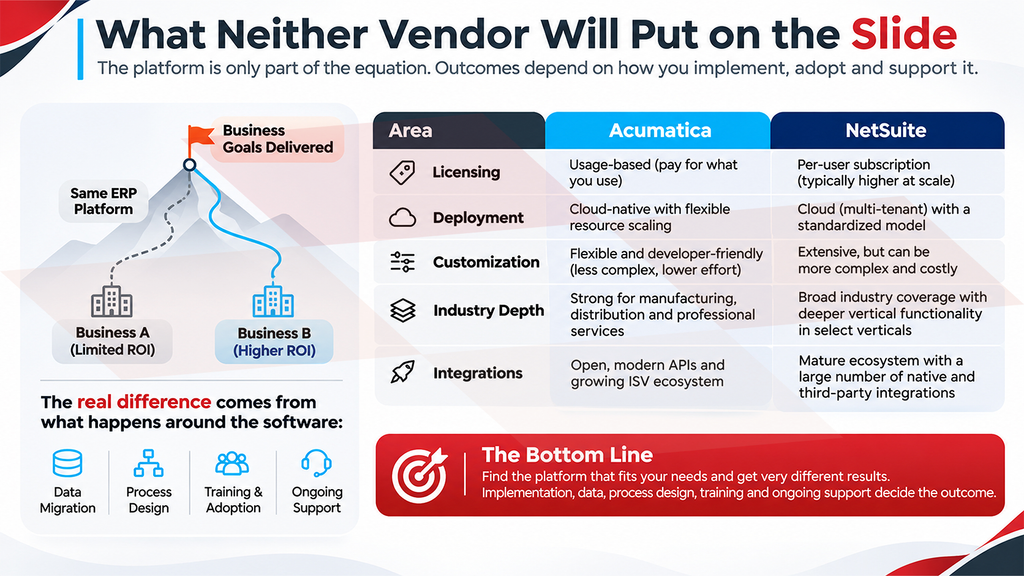
Acumatica is widely recognised for its distribution, manufacturing and construction capabilities, with editions and applications built for those operations. NetSuite is known for broad horizontal coverage across many industries and a large module library.
The point for decision-makers: broad coverage and deep coverage are different strengths. If your core workflows are specialised, such as complex inventory, project costing, or production, test those exact workflows in a scripted demo before you decide.
Explore our Acumatica implementation and consulting services or see how we have delivered for other businesses in our case studies.
FAQs:
1. Which is better for a multi-location business?
Both can support multi-location operations. Acumatica’s distribution, manufacturing and construction depth and its deployment options suit specialised, multi-site workflows, while NetSuite suits businesses that want one standardised cloud-only suite. Validate against your own locations in a scripted demo.
2. Does Acumatica charge per user?
No. Pricing is based on the applications licensed and a resource and transaction tier, with unlimited users.
3. Can NetSuite run on-premises?
No. NetSuite is cloud-only, while Acumatica offers public cloud, private cloud and perpetual license options.
4. What are the risks of an ERP implementation for a growing business?
Risk concentrates in scope, data migration and customization; a phased rollout tied to business outcomes reduces it.
5. How do Acumatica and NetSuite handle multiple locations and legal entities?
Both support multi-location and multi-entity operations. What differs is how much each needs configuring, extending and consolidating for your structure.
6. Which is better for distribution, manufacturing or construction businesses?
Acumatica is known for depth in these industries, with applications built for them. NetSuite covers a broad range of industries. Whichever you shortlist, prove your core workflows on your own data before deciding.
7. Can Acumatica integrate with e-commerce, CRM and POS systems?
Yes. Acumatica has open APIs, and Greytrix’s GUMU™ platform connects ERPs with e-commerce, CRM, POS and payment gateways. [CONFIRM: current GUMU connector list for Acumatica]
8. How do we avoid customization problems at upgrade time?
Plan customization around business outcomes, package it so it can be versioned and retested, and ask your partner who owns retesting at each major release.
9. How long does an implementation take for a multi-location business?
[CONFIRM: Greytrix typical Acumatica implementation timelines by scope and number of locations]
10. We already have an ERP. Should we migrate?
If your current system cannot support new locations, entities or channels without workarounds, compare both platforms against a written list of those requirements. Migration scope and data quality usually drive risk more than the platform choice.
11. What should the board ask before choosing?
Start with the five questions in the “How to Choose a Cloud ERP” section above, and insist on a scripted demo using your own locations and workflows.
About Us
Stay ahead of the curve with our latest insights, trends, and expert perspectives that decode technology’s role in shaping modern enterprises. From emerging market shifts to hands-on implementation strategies, Tech Talk brings you practical knowledge designed to help you make smarter, faster, and future-ready business decisions.
From consultation to implementation, migration, and custom development, we help organizations transform complex business processes into connected, data-driven workflows enabling smarter decisions, better collaboration, and sustainable growth.
At Greytrix, we blend human expertise with intelligent technology so your business can move faster, adapt quicker, and stay future-ready.
Ready to modernize your business stack? Talk to our experts today.