
Demand forecasting challenges in manufacturing and production planning issues in manufacturing are often discussed separately, even though they are two sides of the same coin.
Demand forecasting defines what the business expects to sell. Production planning determines what the business commits to build. In theory, one informs the other. In reality, the connection weakens as assumptions change, costs shift, and execution begins.
What starts as a shared plan gradually diverges into parallel processes. Forecasting continues to evolve while production planning absorbs the consequences. The result is not immediate failure, but a series of adjustments that quietly reshape schedules, inventory positions, and financial outcomes.
This is where manufacturers struggle with demand forecasting vs. production planning in practice. An integrated financial and operational view, supported by solutions such as Sage Intacct for Manufacturing, can help connect planning decisions with their financial impact, giving manufacturers greater visibility as conditions change.
The Real Issue Isn’t Forecast Accuracy
Then what is?
A 2025 global risk survey found that 81% of companies had experienced supplier disruptions in the past two years, with 62% now rating supply chain risk as high or very high — that’s from Manufacturing Engineering & Technology
Where manufacturers are forced to adjust:
Over time, this lack of visibility changes how decisions are made:
- Plans are approved with larger cost buffers
- Purchase and production commitments are delayed to protect cash flow
- Inventory decisions are made cautiously, without full clarity on AP, AR, and stock impact
The organization still plans, but with tighter cash controls and reduced confidence.
It is not a tooling problem. It is a cost and working capital visibility problem.
If your planning process still surfaces cost and cash impact only after the quarter closes, that’s usually a visibility gap rather than a forecasting one. Greytrix works with manufacturers to connect Sage Intacct’s financial layer to existing planning and production systems — worth a conversation if forecast-to-actual drift is eating into your working capital.
Why Finance Must Validate Planning Earlier
- Demand forecasting answers what might happen.
- Production planning determines what will be done.
- Finance clarifies what it will cost and what it will impact.
When finance is introduced late in the planning cycle, misalignment becomes expensive. When finance validates assumptions earlier, misalignment becomes visible while options still exist—especially in environments relying on ERP for manufacturing planning to coordinate operations and finance.
Early Financial Validation Changes Behavior
When planning decisions are continuously checked against cost, margin, and cash impact:
- Fewer assumptions go unchallenged
- Scenarios are evaluated before commitments are made
- Adjustments happen earlier and cost less
These shifts move planning from damage control to decision control.
Rethinking Success in Demand Forecasting and Production Planning
Forward-looking manufacturers are redefining what “good planning” looks like.
They are no longer asking:
- How accurate was the forecast?
They are asking:
- How quickly did forecast vs actual performance start to diverge?
- Which products, locations, or entities required mid-cycle correction?
- How predictable were the financial outcomes across the business?
This shift reflects a more mature understanding of planning—one that depends on forecast to actual reporting in Sage Intacct and multi-dimensional visibility, not one-time precision.
When performance can be analyzed by product, location, and legal entity, planning moves beyond assumptions and into measurable control—where confidence comes from knowing where misalignment is forming and how it affects the business. Sage Intacct addresses this by keeping planning decisions financially visible as execution unfolds.
Sage Intacct does not replace manufacturing planning systems. It provides the financial layer that validates plans as conditions change.
How Sage Intacct Supports Fewer Surprises in Manufacturing
Rather than adding another forecasting layer, Sage Intacct for manufacturing strengthens the connection between planning decisions and financial reality.
By providing:
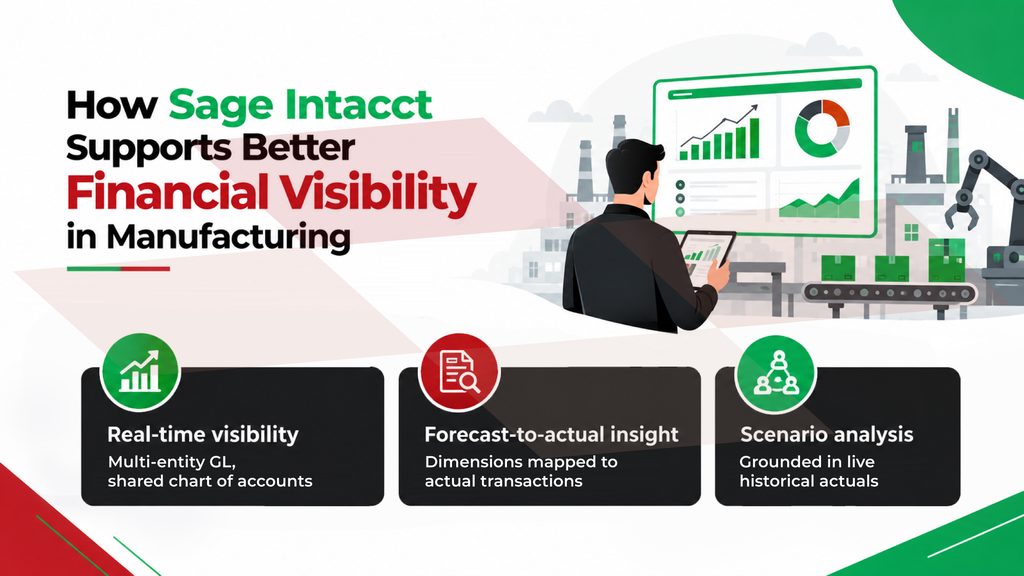
Sage Intacct enables manufacturing leaders to validate plans financially as conditions change—not after execution begins. As manufacturing financial management software, it connects planning decisions directly to cost, margin, and cash impact.
The outcome is not perfect forecasts.
It is fewer late-stage corrections and more predictable outcomes.
Sage Intacct enables “what-if” analysis using posted financial transactions and historical actuals.
Extending Manufacturing Visibility with Sage Distribution and Manufacturing Operations
Sage Intacct serves as the financial system of record, while Sage Distribution and Manufacturing Operations, an advanced module, extends visibility into manufacturing execution.
- SDMO supports operational tracking of production activity, inventory movement, and WIP.
- Production and material consumption data from SDMO flow into Sage Intacct, strengthening forecast-to-actual analysis.
- Financial impact of production changes is reflected more directly, improving alignment between planning assumptions and execution results.
This approach keeps financial control centralized while enabling deeper manufacturing insight.
A Practical Example: When Forecasts Are Right but Outcomes Still Drift
Consider a mid-sized manufacturer with multiple product lines and regional demand variation.
At the start of the quarter, demand forecasts are approved based on historical trends and current sales input. Production plans are finalized accordingly—capacity is allocated, materials are ordered, and labour schedules are set. From a planning standpoint, the process is sound.
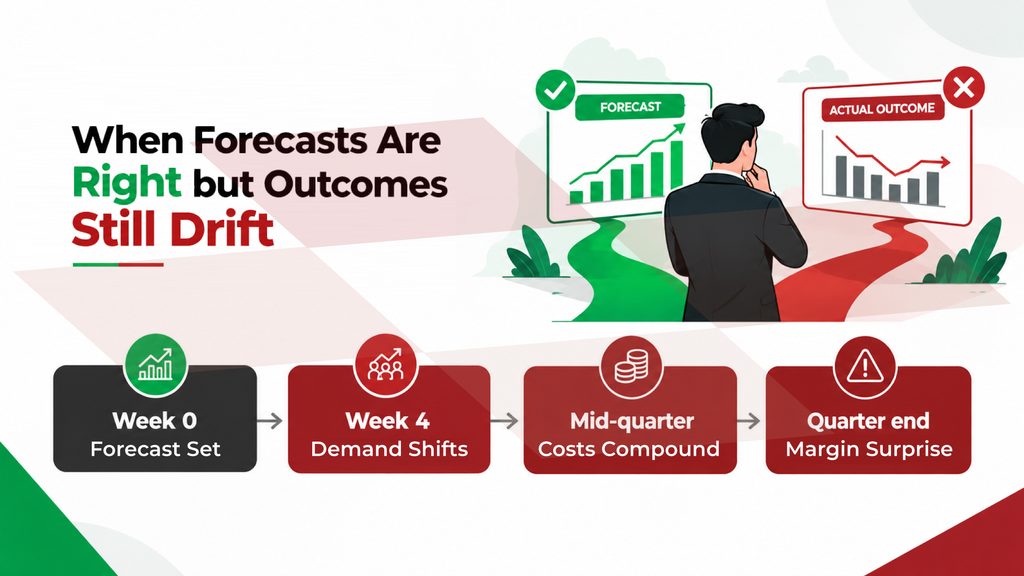
Four weeks into execution, demand begins to shift. One product line sees higher-than-expected orders, while another slows. Individually, these changes don’t trigger concern. The forecast is updated. Operations adjusts sequencing on the shop floor to stay responsive.
What doesn’t change immediately is the financial context behind those adjustments.
Expedited materials are brought in to support the high-demand line. Overtime is approved to meet revised delivery timelines. Inventory builds quietly on slower-moving SKUs. Each decision makes operational sense in isolation, and none appear problematic on their own.
By the time finance reviews the quarter, the impact is clear: margins are tighter than expected, working capital is under pressure, and variance explanations point to a collection of small decisions rather than a single failure.
The production plan wasn’t poorly executed. What was missing was early financial validation as assumptions changed—visibility into how operational adjustments were compounding financially while there was still time to respond differently.
This is the pattern many manufacturers recognize. Not a breakdown in planning, but a gradual drift that only becomes visible after execution has already absorbed the cost.
Planning That Holds Is Better Than Planning That Predicts
Manufacturing leaders do not need more forecasting tools. They need planning processes that hold up as reality changes.
Demand forecasting and production planning work best when they remain financially connected throughout execution—not just at approval. When financial visibility arrives early enough to influence decisions, surprises diminish, corrections decrease, and confidence returns—especially when supported by cloud financial management for manufacturers.
In manufacturing, success is not defined by perfect predictions. It is defined by plans that remain dependable when conditions shift.
FAQs:
1. What’s the difference between demand forecasting and production planning?
Demand forecasting estimates what a business expects to sell. Production planning determines what it commits to build — capacity, materials, and labor allocated against that estimate. The two are meant to move together, but forecasting keeps evolving as conditions change while production planning has already locked in commitments, which is where the gap between them opens.
2. Why does financial visibility matter in manufacturing planning?
Because demand and production plans can both look sound on paper while the cost and cash impact of executing them stays hidden until finance reviews the quarter. When financial validation happens alongside planning instead of after it, assumptions get challenged earlier, scenarios get tested before commitments are made, and corrections cost less because they happen while options still exist.
3. Does Sage Intacct replace manufacturing planning systems?
No. Sage Intacct doesn’t replace manufacturing planning or execution systems — it provides the financial layer that validates those plans as conditions change, keeping cost, margin, and cash impact visible throughout execution rather than only at quarter-end.
4. What is Sage Distribution and Manufacturing Operations (SDMO)?
SDMO is an advanced module that extends Sage Intacct’s visibility into manufacturing execution — tracking production activity, inventory movement, and work-in-process. Production and material consumption data from SDMO flows into Sage Intacct, strengthening forecast-to-actual analysis while keeping financial control centralized.
About Us
Greytrix has a wide product range for Sage Intacct- a Cloud ERP. This includes migrations from QuickBooks | Sage 50 | Sage 100 | Sage 300 to Sage Intacct. Our unique GUMU™ integrations include Sage Intacct for Sage CRM | Salesforce | FTP/SFTP | Rev.io | Checkbook | Dynamics 365 CRM | Magento | Rent Manager | Treez | Avalara Avatax | Blackline SFTP. We also offer best-in-class Sage Intacct Development Services, Consulting services, integrated apps like POS | WMS | Payroll | Shipping System | Business Intelligence | eCommerce for Sage Intacct to Sage business partners, resellers, and Sage PSG worldwide. Greytrix constantly develops apps, products, and add-ons to enhance user experience. Sage Intacct add-ons include AR Lockbox File Processing.
Greytrix GUMU™ integration for Sage CRM – Sage Intacct, Sales Commission App for Sage Intacct, and Checkbook.io ACH/Digital Check Payments for Sage powered by GUMU™ are listed on Sage Intacct Marketplace.
The GUMU™ Cloud framework by Greytrix forms the backbone of cloud integrations that are managed in real-time for the processing and execution of application programs at the click of a button.
For more information on Sage Business Cloud Services, please contact us at sagecloud@greytrix.com. We will like to hear from you.