
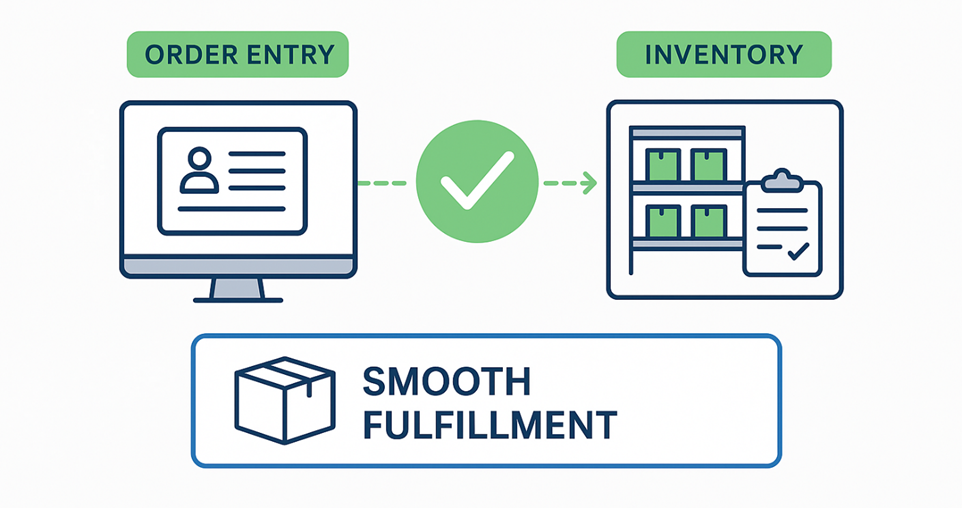
In today’s fast-moving business environment, efficient order fulfillment is a critical factor in maintaining customer satisfaction as well as maintaining operational and business profitability. Many organizations face challenges such as delayed shipments, inventory discrepancies, and errors caused by disconnected sales and warehouse processes. Sage Intacct, a leading cloud-based ERP system, eliminates these challenges by strongly integrating the order entry and inventory management.
- Advantage of Integration
- Real-time Inventory Accuracy
Every order, shipment, or return automatically updates inventory records. This ensures that stocks are always updated. This also minimizes issues like overselling, backorders, or shortages. They also make sure quantities are always current. This feature helps management to always overlook the stock across all locations.
.
2. Faster Order Fulfilment
The integration eliminates manual coordination between sales and warehouse teams. Automation speeds up the order processing cycle from picking and packing to shipment. This ensures reducing delays and improves customer satisfaction.
3. Better decision making with Analytics
Through Sage Intacct’s dashboards and reports— which help the businesses monitor sales trends, stock movement, and order performance. Decision-makers can forecast demand by using actual sales patterns and seasonal trends to predict future stock needs. Warehouses can prevent excess inventoy.
4. Scalability for Business Growth
Sage intacct’s cloud-based design to grow your business. Whether you are adding a new warehouse or expanding the locations or handling over orders. The integration ensures scalability without losing visibility to control.
- How Order Entry and Inventory work in sage intacct
Let’s see how order entry and inventory work with the help of diagram,
- Sales Order Creation
When the sales team enters a sales order in the system. The system will automatically monitor for stock availability. And if stock is not available, the system alerts the user for back-order process.

2. Inventory Allocation
The system will automatically allocate available stock for the order. The ‘’Available” quantity will decrease and the “Reserved” quantity will increase in real time; it helps to prevent duplicate entry in the system.
3. Picking and Packing Process
The system will automatically generate picking and packing lists. The warehouse staff uses this list to collect and pack the order. Each lot has its barcode labelled, allowing system- based scanning for accurate order identification and box confirmation.
4. Shipment Update
The shipment will update the sage intacct system, inventory level, shipment date, and tracking detail. And the order fulfilment status (changed to shipped) as well as COGS updated automatically.
5. Invoice and Financial Update
After shipment is done, sage intacct automatically updates the invoice and update accounting records. This ensure revenue recognition and no manual entries are needed.
6. Real time Data
All the data of sales, inventory, and finance stay real-time data on all platforms. This helps organizations to overlook real-time visibility on stock availability, order process, and cash flow.
Conclusion:
As businesses grow, managing multiple businesses together becomes complex. Sage intacct simplifies this with cloud-based integration, ensuring every sales order, shipment, and financial update. This helps businesses to store all data on one single platform. With the help of order entry and inventory, a business can keep an eye on all departments, from ordering to shipment. The integration not only improves efficiency but also strengthens customer satisfaction and supports business growth in the long term.