
In Salesforce development, writing code that works across multiple objects without duplicating logic is a common challenge. Traditionally, developers create separate methods or triggers for each object, which can lead to maintenance difficulties and bloated codebases. Polymorphic Apex offers a powerful solution by allowing developers to write generic and reusable code that can dynamically handle multiple Salesforce objects.
In this blog, we’ll explore:
- What Polymorphic Apex is
- Why it is useful in Salesforce development
- How it can be applied in real business scenarios with practical examples
Business Scenario
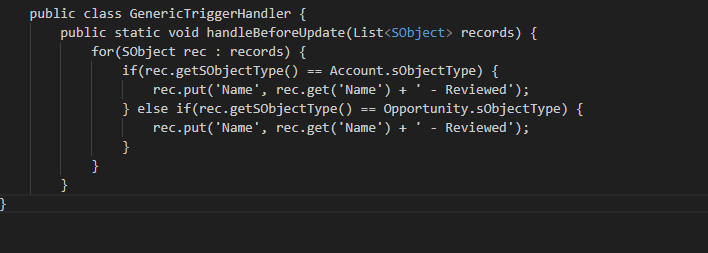
Imagine a company that manages both Opportunities and Accounts, and they want to automatically append “Reviewed” to the name of any record that undergoes a quality check.
Instead of writing two separate triggers – one for Opportunity and one for Account—we can leverage Polymorphic Apex to create a single handler that works for both objects.
This approach:
- Reduces maintenance effort
- Avoids repetitive code
- Ensures consistent logic across objects
What is Polymorphic Apex?
Polymorphism is a concept from object-oriented programming that allows a single interface or variable to represent multiple types.
In Salesforce Apex, polymorphism is typically achieved using the SObject type.
The SObject type is a generic data type that can represent any Salesforce object, whether standard or custom.
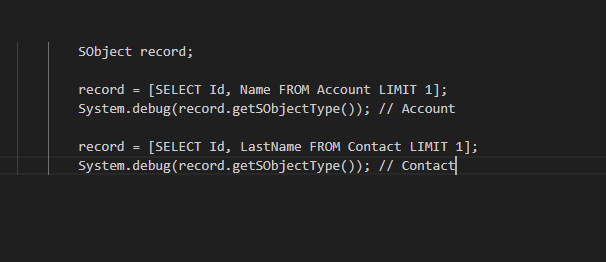
Developers can use methods such as:
- getSObjectType()
- instanceof
These methods help determine the actual object type at runtime, allowing code to behave dynamically depending on the object.
Using SObject for Flexible Methods
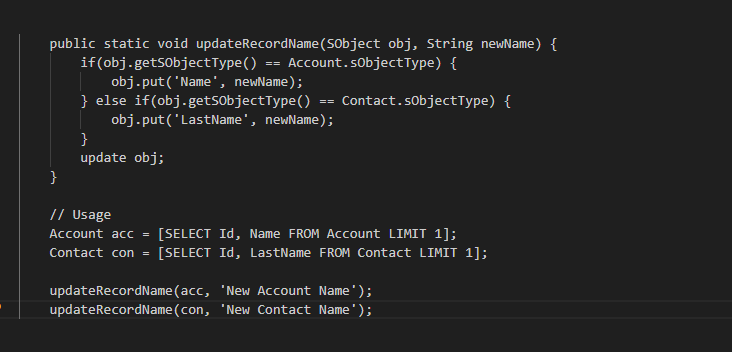
By passing SObject variables to methods, developers can perform operations dynamically across different objects.
Instead of writing separate logic for each object, a single reusable method can process multiple object types efficiently.
Polymorphic Triggers
Triggers can also benefit from polymorphism. Rather than creating separate triggers for each object, developers can implement a generic trigger handler that works across multiple objects.
This improves:
- Code reusability
- Maintainability
- Consistency in business logic
Polymorphic Relationships
Salesforce also supports polymorphic relationship fields, such as:
- WhoId
- WhatId
These fields are commonly used in Tasks and Events, allowing them to reference multiple objects dynamically.
Developers can use getSObjectType() to determine which object the field references and apply the appropriate logic in Apex.
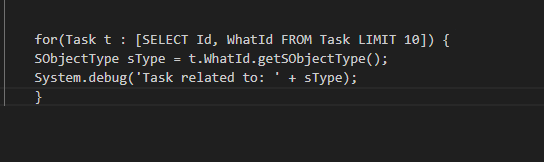
This approach allows developers to write generic logic for tasks linked to any object, eliminating the need to create separate methods for each object type.
Best Practice
Avoid overusing polymorphism.
Polymorphic Apex should primarily be used for reusable and generic functionality.
For simple, single-object logic, using standard object-specific code may be more appropriate and easier to maintain.
Conclusion
Polymorphic Apex is a powerful technique that allows Salesforce developers to build flexible, maintainable, and reusable code. By leveraging the SObject type and runtime type detection, developers can reduce duplication, simplify trigger frameworks, and efficiently handle multiple object types within a single implementation.
When applied appropriately, polymorphism improves code scalability, maintainability, and development efficiency in Salesforce projects.
By following the above blog instructions, you will be able to learn “Polymorphic Apex in Salesforce: How to Write Flexible Code for Multiple Objects“. If you still have queries or any related problems, don’t hesitate to contact us at salesforce@greytrix.com. More details about our integration product are available on our website and Salesforce AppExchange.
We hope you may find this blog resourceful and helpful. However, if you still have concerns and need more help, please contact us at salesforce@greytrix.com.
About Us
Greytrix – a globally recognized and one of the oldest Sage Development Partner and a Salesforce Product development partner offers a wide variety of integration products and services to the end users as well as to the Partners and Sage PSG across the globe. We offer Consultation, Configuration, Training and support services in out-of-the-box functionality as well as customizations to incorporate custom business rules and functionalities that require apex code incorporation into the Salesforce platform.
Greytrix has some unique solutions for Cloud CRM such as Salesforce Sage integration for Sage X3, Sage 100 and Sage 300 (Sage Accpac). We also offer best-in-class Cloud CRM Salesforce customization and development services along with services such as Salesforce Data Migration, Integrated App development, Custom App development and Technical Support business partners and end users. Salesforce Cloud CRM integration offered by Greytrix works with Lightning web components and supports standard opportunity workflow. Greytrix GUMU™ integration for Sage ERP – Salesforce is a 5-star rated app listed on Salesforce AppExchange.
The GUMU™ Cloud framework by Greytrix forms the backbone of cloud integrations that are managed in real-time for processing and execution of application programs at the click of a button.
For more information on our Salesforce products and services, contact us at salesforce@greytrix.com. We will be glad to assist you.
Related Posts