
If you run a distribution or supply chain operation, you already know the pressure. Stockouts alone cost U.S. retailers an estimated $1.75 trillion yearly. Inventory carrying costs quietly drain working capital. And the systems most businesses are running — disconnected tools, manual reconciliations, spreadsheet-dependent reporting — were not built for the speed at which supply chains now have to operate.
The question most operations heads and CFOs are asking isn’t whether to upgrade. It’s which ERP can actually handle the complexity without creating new ones. Acumatica Distribution ERP is one of the more credible answers to that question — not because it checks feature boxes, but because of how it’s architected to handle the realities of modern distribution. Here’s what that looks like in practice.
Is Acumatica Good for Distribution Companies?
Before getting into what Acumatica does well, it’s worth naming what most distribution ERPs get wrong.
Average inventory accuracy across businesses sits at only 83%, while world-class organizations achieve 95% — this 12-point gap translates to stockouts causing $1 trillion in missed global sales annually. For a mid-sized distributor, that gap isn’t abstract. It shows up in emergency purchase orders, overstocked slow-movers, and a finance team that spends more time reconciling data than analyzing it.
The root cause is almost always architectural: inventory data living in one system, procurement in another, financials in a third, and no single source of truth connecting them in real time.
Leading ERP systems can now predict demand shifts 6–8 weeks out with 85%+ accuracy — but only when the underlying data architecture is clean enough to support it. That’s the bar Acumatica is built to meet.
Can Acumatica Support Multiple Warehouses?
Acumatica Distribution Edition is designed to connect every stage of the distribution lifecycle—from purchasing and receiving to inventory control, sales orders, shipping, and customer service. Instead of forcing teams to work across multiple disconnected systems, it provides a unified operational environment where inventory, warehouses, procurement teams, sales teams, and finance teams work from the same data foundation. This allows distributors to improve fulfillment performance, reduce manual coordination, increase inventory accuracy, and make faster decisions as business complexity grows.
Here’s how Acumatica addresses the challenges distributors face every day:
- End-to-End Inventory Visibility Across Every Location
Acumatica gives you complete real-time visibility and control over every aspect of your distribution operations — helping you manage inventory levels to avoid shortages or overstocking, optimize procurement processes, and streamline fulfillment from a single platform.
For operations heads managing multiple warehouses, this is the difference between knowing your inventory position and believing you know it. Lot and serial number tracking, automated replenishment triggers, and real-time stock movement across locations — these aren’t add-on modules. They’re part of the core distribution engine.
The practical impact: fewer emergency buys, fewer write-offs, and procurement decisions made on actual demand signals rather than stale reports.
- AI-Powered Demand Forecasting That Reduces Working Capital Exposure
Acumatica AI Studio — introduced in the 2026 R1 release — goes beyond static forecasting. It detects anomalies in purchasing patterns, predicts demand shifts, and surfaces intelligent recommendations for inventory, cash flow, and production planning before the problem appears in your P&L.
50% of companies now use AI for inventory demand prediction, with 80% citing improved accuracy. For CFOs, that accuracy improvement translates directly into working capital optimization — less cash tied up in excess stock, fewer revenue hits from stockouts, and a cleaner cash conversion cycle.
- Mobile-First Access Built for the Shop Floor, Not Just the Corner Office
Most ERP systems were designed to be used from a desk. Acumatica was designed to be used from wherever work actually happens — factory floors, construction sites, loading docks, client locations.
Full ERP functionality on smartphones and tablets, with offline mode that syncs when connectivity is restored. Warehouse staff can execute picks, receipts, and transfers from a mobile device. Field teams can access inventory and order data without calling back to a coordinator. The system goes where the operation goes.
Acumatica includes built-in warehouse management tools with full support for barcode scanning and mobile devices — warehouse teams can perform key tasks from any mobile scanner, tablet, or smartphone.
Take a look at our Brochure – https://www.greytrix.com/wp-content/uploads/2026/06/ERP-Playbook-for-Modern-Warehouse.pdf
Does Acumatica Charge Per User?
This is one of Acumatica’s most structurally significant differentiators — and one that consistently changes the ROI conversation.
Most ERP pricing models charge per named user. The result: businesses limit system access to a subset of their team, which means data entry bottlenecks, delayed visibility, and workarounds that defeat the purpose of having an integrated system in the first place.
Managing multiple disconnected systems leads to mounting expenses — licensing fees, custom integrations, and ongoing support quickly add up. Acumatica removes the per-seat constraint entirely. You pay for consumption — the computing resources you use — not headcount. Your entire shop floor, warehouse staff, and site teams can be in the system without triggering a licensing conversation every time you hire. For IT managers, this also simplifies procurement and budget forecasting significantly.
Why Implementation Partner Selection Matters as Much as Platform Selection
Choosing Acumatica is the first decision. Implementing it correctly for your specific distribution model is the second — and often the harder one.
Acumatica is an extensively configurable platform. That configurability is a strength when the implementation is led by someone who understands both the system’s architecture and the operational realities of your industry. It becomes a liability when it isn’t.
The specific challenges that consistently derail distribution ERP implementations include: setting the right inventory valuation methodology for your cost structure, configuring demand forecasting parameters to reflect your actual lead times and supplier behavior, designing multi-warehouse fulfillment rules that match how your operation runs, and integrating Acumatica with existing 3PL, EDI, or eCommerce infrastructure without creating new data gaps.
These aren’t technical problems in isolation. They’re business alignment problems that require someone who speaks both languages.
| Implementation Area | Without a Partner | With a Certified Partner |
| Inventory valuation setup | Default costing method applied regardless of business model | FIFO, LIFO, or WAC configured to match actual cost structure and reporting requirements |
| Demand forecasting configuration | Out-of-box parameters used; forecasts don’t reflect real lead times or supplier variability | Forecasting rules calibrated to historical purchasing data, supplier lead times, and seasonal patterns |
| Multi-warehouse fulfillment rules | Generic routing logic; manual overrides required for exception handling | Fulfillment rules designed around actual warehouse hierarchy, priority logic, and transfer order workflows |
| 3PL / EDI / eCommerce integration | Point-to-point connectors built ad hoc; break under volume or schema changes | Integration architecture designed for resilience, with mapped data flows and exception handling built in |
| User adoption | System configured for IT; floor staff and warehouse teams work around it | Role-based access and mobile workflows designed for how each team actually operates |
| Time to ROI | Delayed — months of post-go-live corrections and workarounds | Accelerated — environment is production-ready at go-live, not after it |
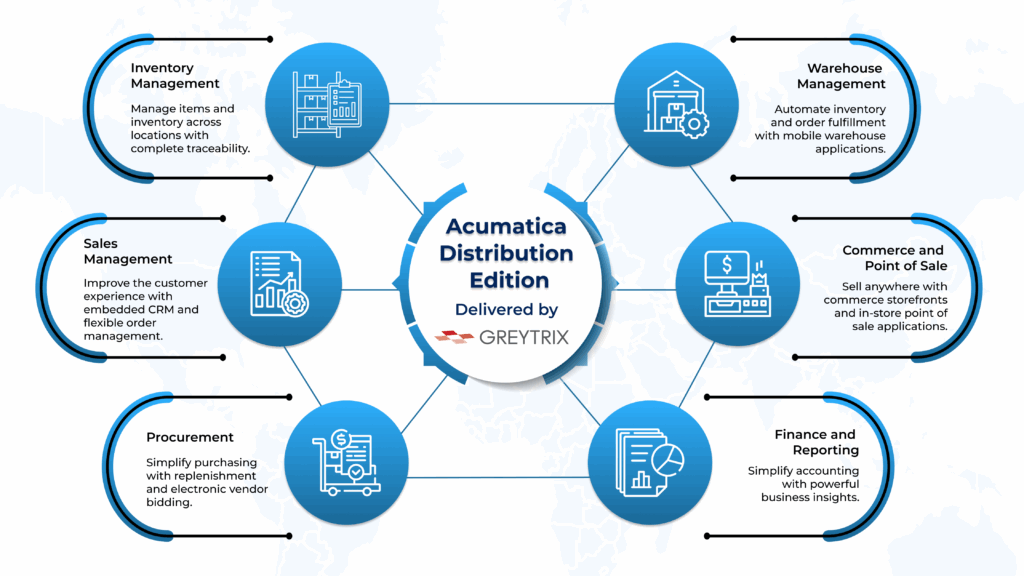
Acumatica Distribution Edition runs on a unified data model connecting six functional domains — Inventory Management, Finance and Reporting, Sales Management, Procurement, Warehouse Management, and Commerce and Point of Sale — each reading from and writing to the same transactional core rather than syncing through batch integrations. A warehouse stock movement updates cost layers and GL postings in real time, while the same inventory data simultaneously drives available-to-promise checks in Sales and replenishment triggers in Procurement. Commerce and POS transactions post directly into this ledger, removing the reconciliation lag typical of bolted-on commerce integrations. For distribution businesses managing multi-location inventory and landed cost allocation, this single-instance architecture is what enables real-time margin visibility — instead of discrepancies surfacing only at month-end close.
Know more details:
https://www.greytrix.com/wp-content/uploads/2026/06/Distribution_Edition_Applications.pdf
Working With Greytrix on Your Acumatica Implementation
Greytrix is a certified Acumatica implementation and consulting partner. Our team works specifically with distribution and supply chain businesses — which means the configuration decisions we make are informed by operational context, not just platform defaults.
Whether you’re evaluating Acumatica for the first time, migrating from a legacy system, or optimizing an existing environment that isn’t performing to expectation, the engagement starts the same way: understanding how your supply chain actually operates before recommending how the system should be configured.
Ready to evaluate Acumatica for your distribution operation?
Talk to our certified Acumatica consulting team:
https://bookings.cloud.microsoft/book/LetsbookaCoffeeTime@greytrix.com/
About Us:
Greytrix has a wide product range for Acumatica. A Cloud ERP with unique GUMU™ integrations include Acumatica for Shopify | Magento | Dynamics 365 CRM.
The GUMU™ Cloud framework by Greytrix forms the backbone of cloud integrations that are managed in real-time for the processing and execution of application programs at the click of a button.
We also offer best-in-class Acumatica Development Services, Consulting Services for Acumatica to Acumatica business partners, resellers, and Acumatica VARs worldwide. Greytrix constantly develops apps, products, and add-ons to enhance user experience.
For more information on Acumatica Cloud Services, please contact us at acumatica@greytrix.com. We will like to hear from you.