

Acumatica Shopify Integration & Acumatica Magento Integration: How GUMU™ Prevents Duplicate Customer Records
Running ecommerce on Shopify or Magento while managing operations in Acumatica Cloud ERP means your two most important systems need to stay in sync — products, orders, inventory, pricing, and customer records, all of it. When that sync works properly, orders close faster, inventory stays accurate across channels, and your finance team isn’t chasing discrepancies at month-end. When it doesn’t, the problems are rarely loud. They’re quiet — a customer count that doesn’t quite match, a lifetime value figure that looks lower than it should, a marketing segment that disagrees with what Sales already knows about a buyer.
GUMU™ by Greytrix is built specifically for Acumatica Shopify integration and Acumatica Magento integration, and it handles the full range of data your ecommerce and ERP systems need to share. But it does one thing most connectors skip entirely: before creating a new customer record, it checks whether that customer already exists in Acumatica. That single step is the difference between a database that stays accurate and one that quietly accumulates duplicates — particularly from guest checkout orders, where the platform has no persistent ID to hand off in the first place.
This article covers exactly what GUMU™ syncs, why the guest checkout problem creates data debt that compounds every month it goes unaddressed, and what changes once identity matching sits inside the sync itself instead of being left as a cleanup job for later.
What Unmatched Guest Checkouts Actually Cost
The math is straightforward, even if the symptom rarely looks like one. Customer Acquisition Cost divides total marketing spend by customers acquired — if a third of those “acquired customers” are actually repeat buyers counted again under separate guest-checkout records, CAC looks better than it really is, right up until someone reconciles it against revenue per buyer and the numbers stop adding up.
Lifetime value takes the same hit from a different angle. A customer with $1,200 in total purchases across three orders shows up in Acumatica as three separate customers, each worth $400. The high-value segment your Marketing team is trying to identify and grow becomes invisible in the data — not because those customers aren’t valuable, but because their value is split across records that don’t know about each other.
And it doesn’t stay contained to one team. Marketing builds audience segments off purchase history in Acumatica. Sales tracks repeat buyers off their own conversations and CRM notes. When the underlying customer count is inflated with duplicates, the two teams end up working from numbers that were never going to agree — and because it’s “just the ERP,” nobody thinks to question which side is actually wrong.
Here’s what that divergence looks like over time, for an ecommerce business with steady guest checkout volume and no identity matching in place:
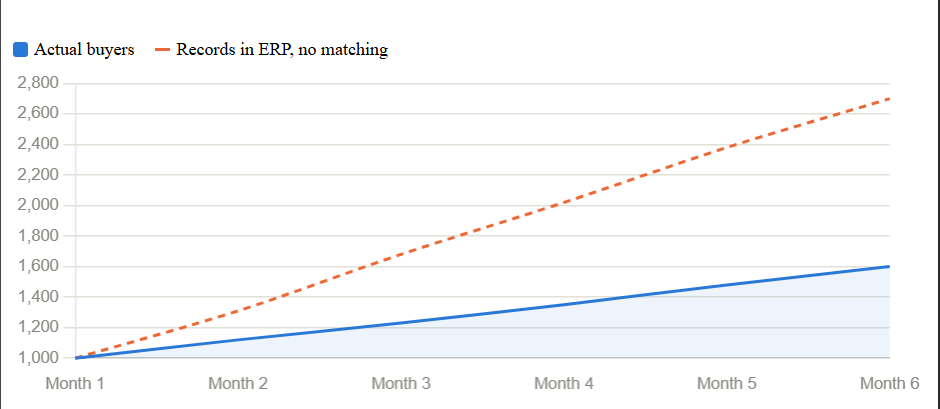
That gap in the chart is the default trajectory for any Acumatica Shopify and Magento integration that doesn’t check for an existing customer before creating a new one.
What GUMU™ Actually Syncs
| Module | What GUMU™ does |
| Products | Full catalog kept identical across Acumatica, Shopify, and Magento |
| Orders | Synced in real time, online and offline, from both platforms |
| Invoices | Generated and reconciled against the originating order automatically |
| Customers | Matched against existing Acumatica records before a new one is created — the step most vendors skip entirely |
| Prices | Pricing tiers and rules kept aligned across every connected storefront |
| Discounts & promotions | Promotional pricing carried through to Acumatica, not left behind at checkout |
| Inventory | Synced across every channel in real time — no overselling gaps |
| B2B data | B2B order and account structures alongside standard B2C sync |
Quick self-check: is this already happening to you?
You likely have this problem, quietly, if any of these are true:
- Guest checkout is enabled and used by a meaningful share of your buyers
- Your Acumatica customer count has grown faster than your actual repeat-buyer base
- Customer lifetime value figures look lower than expected for what should be repeat customers
- Marketing segmentation by purchase history doesn’t match what Sales says about known repeat buyers
- Nobody on your team can say, with confidence, how customer records get matched on sync
None of these show up as an error message. They show up as numbers that feel slightly off, in a system nobody thinks to question because it’s “just the ERP.”
Customer Acquisition Cost math breaks. CAC divides total marketing spend by customers acquired. If a third of your “acquired customers” are actually repeat buyers who were counted again, your CAC looks better than it is — until someone reconciles it against revenue per buyer, and the numbers stop adding up.
Lifetime value figures are understated. A customer with $1,200 in total purchases across three orders shows up as three customers, each with $400. The high-value segment your Marketing team is trying to grow becomes invisible in the data.
Marketing and Sales disagree on the numbers. Marketing segments by purchase history in Acumatica. Sales manages relationships directly. When the underlying customer count is inflated with duplicates, the two teams are working from data that was never going to match — and nobody thinks to question the ERP because “that’s just how it works.”
How GUMU™ Stops Duplicate Customer Records During Acumatica Shopify & Magento Sync
Here’s the actual decision GUMU™ makes on every order, and why it matters more than it sounds. Most integrations do one thing: order arrives, record gets written. No pause, no check. GUMU™ adds one step first — it asks Acumatica, in real time, “does this email already exist as a customer?” Match found, the order attaches to that customer. No match, exactly one new record gets created.
Small decision, big consequence — it’s the difference between a customer database that reflects your real buyers and one that’s been quietly multiplying them for years.
It’s not blind matching, either. If an email matches but the name or address suggests a different person — a shared inbox, say — GUMU™ won’t force the merge. A wrongly merged record is worse than a duplicate one, so it stays cautious when the evidence isn’t clean.
Run the Math After Implementing GUMU™
The formula is simple:
(Monthly orders) × (% that are guest checkouts) × (% of guests who order more than once) = duplicate records prevented per month
Say you are running 5,000 orders a month, at 30% guest checkout, seeing roughly 20% of those guests come back and order again. That’s still 300 orders a month from someone who’s already a customer in Acumatica. The difference: GUMU™ checks for that existing customer before writing anything. Match found, order attaches to the record that’s already there.
300 records prevented a month. Not cleaned up after the fact, but never created in the first place.
Run it forward the same way you would have without GUMU™: at 300 a month, that’s 3,600 customer records that stay accurate over a year, instead of 3,600 duplicates someone eventually has to untangle. Every one of those 300 monthly orders now lands on the right customer’s history — so their lifetime value reflects everything they’ve actually bought, your CAC math divides spend by real new customers instead of inflated headcount, and Marketing’s segmentation finally agrees with what Sales already knew about that buyer.
Same order volume. Same guest checkout behavior. The only variable that changed is whether the system asked one question before writing a record — and that one question is the difference between a customer database that compounds against you and one that compounds for you.
What Good Looks Like
Twenty-five years of implementing Acumatica across manufacturing, distribution, and retail has taught us one thing about ecommerce integration specifically: the vendors who get it right treat identity matching as a core requirement, not an add-on you discover you needed after the fact.
That’s the standard Greytrix holds every Acumatica Shopify integration and Acumatica Magento integration to. Not “does it move orders” — every connector does that. The real question is whether it moves orders correctly, with enough judgment built in to recognize a returning customer instead of manufacturing a new one. GUMU™ was built around that judgment call from the start, because we’d already seen what happens to clients who found out the hard way, years into running a connector that never asked.
This isn’t a feature we added to compete on a spec sheet. It’s the difference between an integration that quietly costs you accuracy over time and one that protects it by design — and it’s why, when businesses come to us after inheriting a fragmented customer base, the fix isn’t a patch. It’s replacing the underlying assumption the old integration was built on.
See Your Own Numbers Corrected
We opened by asking what your Acumatica customer count is actually measuring. If you’ve read this far, you probably have a rough number in mind now — and maybe a slightly less comfortable one than when you started.
That’s the right place to be. The gap between “customers we have” and “customers we’ve counted” doesn’t close itself, and it doesn’t stay the same size while you decide whether to look into it.
If guest checkout is any real share of your ecommerce orders, it’s worth a direct conversation about whether your current Acumatica Shopify integration or Acumatica Magento integration was built to ask the one question that actually matters. Greytrix can walk you through exactly how GUMU™ handles it — live, against your own numbers, not a generic demo.
FAQs
Duplicate records can appear when an ecommerce platform sends a new guest checkout without a persistent customer ID that the integration can use to identify an existing buyer. If the integration simply creates a new customer record for each incoming order, the same person can gradually end up with multiple profiles.
Yes, provided the integration uses identity-matching logic. Signals such as email can be checked against existing customer records before deciding whether to create a new record or associate the order with an existing one.
A different email makes identity matching less certain. Depending on the integration logic, secondary information such as name or address may help identify a potential match. Where the evidence isn’t strong enough, it’s generally safer to avoid automatically merging two records that may belong to different people.
Yes, but fixing historical duplicates usually requires identifying matching records, merging customer histories and reviewing uncertain cases. As the number of records grows, that cleanup becomes increasingly time-consuming and difficult to manage.
GUMU™ adds matching logic into the Acumatica ecommerce sync, checking whether an incoming customer already exists before creating a new record. This helps repeat buyers remain connected to their existing purchase history instead of creating another customer profile.
No. GUMU™ can also synchronize ecommerce data such as orders, products, pricing and inventory between Acumatica and supported ecommerce platforms, helping keep operational data aligned across systems.
About Us:
Greytrix has a wide product range for Acumatica. A Cloud ERP with unique GUMU™ integrations include Acumatica for Shopify | Magento | Dynamics 365 CRM.
The GUMU™ Cloud framework by Greytrix forms the backbone of cloud integrations that are managed in real-time for the processing and execution of application programs at the click of a button.
We also offer best-in-class Acumatica Development Services, Consulting Services for Acumatica to Acumatica business partners, resellers, and Acumatica VARs worldwide. Greytrix constantly develops apps, products, and add-ons to enhance user experience.