
For a single-entity finance team, month-end close is a known quantity — painful, maybe, but predictable. Add a second entity. Then a fifth. Then a holding structure with intercompany loans and shared services allocations, and something shifts. The close process stops scaling like a process at all and starts scaling like a spreadsheet with too many tabs. Which, honestly, in most cases, is exactly what it’s become.
This isn’t a knowledge gap. Anyone running Sage Intacct multi-entity management already knows what multi-entity means. What’s less obvious is exactly where the architecture breaks, why most ERPs handle it worse than they claim to, and what actually separates Sage Intacct’s approach from the rest of the field.
What Causes Multi-Entity Accounting to Break Down
Three mechanisms account for almost every multi-entity accounting failure we see, and they compound each other.
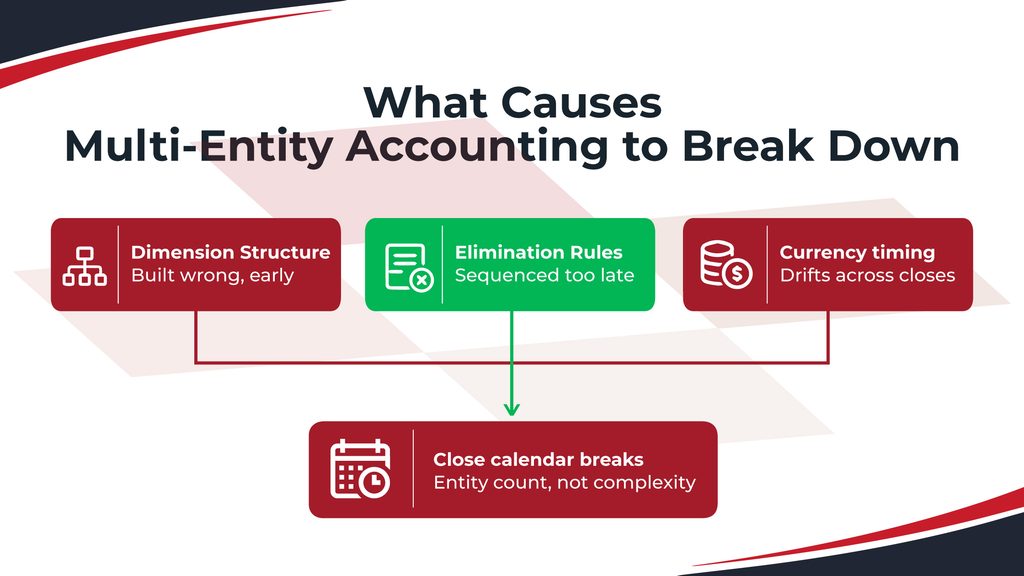
1. Dimensional structuring done wrong, early. Most systems force a choice between building a separate chart of accounts per entity or bolting entities on as a flat tag. Either way, someone eventually needs to report by entity, by department, and by project simultaneously — and if the structure wasn’t built to slice on multiple dimensions at once, every new reporting request means rebuilding account combinations that should have existed from day one.
2. Elimination rules sequenced after the fact, not designed in. Intercompany eliminations aren’t just “subtract the intercompany balance.” A shared services entity billing three subsidiaries, inventory moving between two more before it reaches an external customer, ownership percentages that aren’t 100% — each of these needs an elimination rule with the correct sequencing, or you get a consolidated statement that’s individually correct at the entity level and wrong at the group level. Two ledgers can each be right and still tell the wrong consolidated story.
3. Currency remeasurement timing drift. Multi-currency consolidation complexity. When entities operate in different base currencies, finance teams need to account for currency conversion, revaluation, and translation when preparing consolidated financial statements. Managing these calculations manually can add another layer of work to the close process, particularly as the number of entities and currencies increases.
All three compound under the same condition: a close calendar that’s dictated by the number of entities in the business, not the complexity of any single entity’s books. That’s the tell that the architecture — not the finance team’s effort — is the actual constraint.
How Sage Intacct Multi-Entity Management Solves These Problems
Sage Intacct was built around a multi-entity, multi-dimensional data model from the start, and that shows up as a direct answer to each mechanism above, not a general “yes, we support multi-entity” checkbox.
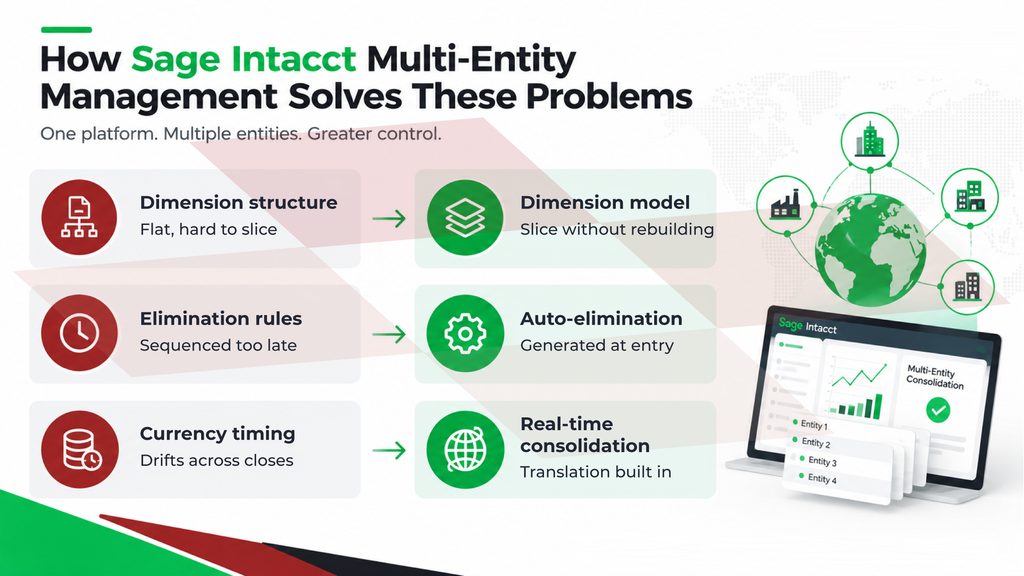
For dimensional structuring:
Sage Intacct’s dimensional accounting model separates the chart of accounts from entity, department, location, and project as independent dimensions you slice by, rather than requiring a proliferating account list for every combination. A team can pull project profitability by location across three entities without a pre-built account for every combination — a structural difference, not a reporting workaround.
Instead of creating separate account combinations for every entity, department, location, and project combination, finance teams can use dimensions to classify transactions and then filter or group financial reports based on those dimensions.
For elimination sequencing:
Sage Intacct supports self-balancing inter-entity transactions and automated eliminations as part of the consolidation process. This reduces the need to manually build both sides of intercompany activity and reconcile every relationship from scratch during close.
For multi-currency consolidation: Sage Intacct supports currency conversion, revaluation, and multi-currency consolidation across entities with different base currencies. Currency translation rules can be defined as part of the consolidation setup, while automated calculations help reduce the manual work involved in preparing consolidated financial statements. Sage Intacct also supports cumulative translation adjustments (CTAs) for ASC 830/FAS-52 compliant multi-currency consolidation.
None of this removes the real judgment calls in a Sage Intacct multi-entity implementation — how entities get dimensioned, how allocation waterfalls get sequenced, how existing intercompany agreements map onto the system’s elimination logic. Get those decisions right and the architecture does what it promises. Get them wrong and you’ve moved the manual work one layer down, not removed it.
Sage Intacct vs. Other ERPs for Multi-Entity Accounting
This is a genuinely contested comparison in the market, and the honest answer is that it comes down to fit, not a universal winner.
NetSuite is the platform most often positioned against Sage Intacct for multi-entity work, and it’s a real contender — particularly at extreme scale (dozens of entities, complex operational ERP needs like inventory and manufacturing alongside finance). Where Sage Intacct pulls ahead is specifically in financial consolidation depth for mid-market multi-entity structures: independent user ratings on G2 put Sage Intacct ahead of NetSuite on both multi-entity consolidation capability (8.6 vs. 7.5) and quality of support (8.1 vs. 7.0), and Software Advice shows Sage Intacct with a marginal overall satisfaction edge as well. Practically, that tracks with what shows up in implementations: Sage Intacct’s dimensional model means finance teams get flexible, ad-hoc reporting without pre-building an account structure for every possible combination, and its native intercompany and consolidation logic tends to get a mid-market entity structure to a clean close faster than a heavier, operations-first ERP built for a different problem.
What a Scalable Sage Intacct Multi-Entity Setup Looks Like
An ERP can say it supports multiple entities. That doesn’t necessarily mean your finance team gets a scalable multi-entity accounting process.
The real test is what happens when complexity enters the picture.
| Ask This About Your ERP | A Basic Multi-Entity Setup | A Scalable Multi-Entity Setup |
| Can we add an entity without redesigning reports? | New entity = new account combinations and reporting workarounds | New entity fits into an existing dimensional reporting structure |
| How are intercompany transactions handled? | Finance identifies and reconciles them during close | Intercompany entries and relationships are built into the transaction flow |
| How are eliminations performed? | Manual adjustments at consolidation | Defined elimination rules applied as part of consolidation |
| What happens when currencies differ? | Additional calculations and reconciliation may be required during consolidation | Currency conversion, revaluation, and translation can be incorporated into the consolidation process |
| Where does consolidated reporting happen? | Export, combine, reconcile, repeat | Consolidation runs from the underlying entity-level data |
| What happens when the business acquires another company? | Another process to bolt onto the close | Another entity to configure within the existing architecture |
The difference is subtle but important. A multi-entity ERP shouldn’t just accommodate more entities. It should reduce the amount of work created by having more entities.
And it’s also why implementation matters more as the entity structure becomes more complex. The technology provides the framework; the implementation determines whether that framework actually reflects how the business reports, transacts, allocates, eliminates, and consolidates.
Planning a Sage Intacct Multi-Entity Implementation
There’s a difference between a finance team that knows how to manage a multi-entity close and a financial system that’s actually designed for multi-entity accounting.
The first depends on people:
“Sarah knows how to reconcile Entity B.”
“Raj maintains the consolidation workbook.”
“Someone needs to check the FX rates before reporting.”
The second depends on architecture.
A scalable multi-entity accounting system should have the right structure from the beginning:
- Dimensional reporting that lets finance teams report across entities, departments, locations, and projects without rebuilding the chart of accounts.
- Intercompany accounting rules that are built into transactions rather than handled as a month-end reconciliation exercise.
- Automated intercompany eliminations that follow the relationships between entities.
- Consistent currency translation for entities reporting in different base currencies.
- Financial consolidation that works from entity-level data rather than manually assembled spreadsheets.
This changes the role of the finance team. Instead of spending the close identifying, reconciling, and correcting issues created by the system structure, finance can focus on reviewing the results and investigating the exceptions that actually require judgment.
That’s the shift: from people remembering how the close works to the system enforcing how it works.
And that’s ultimately what makes a Sage Intacct multi-entity implementation scalable: designing the entity, dimensional, intercompany, currency, and consolidation architecture before the next entity makes those decisions more expensive to change.
Why Sage Intacct Implementation Partners Matter for Multi-Entity Implementation
A single-entity Sage Intacct rollout is mostly a configuration exercise. Multi-entity is closer to a structural design problem — get the entity and dimension architecture wrong at the start, and every report built on top of it inherits that flaw, quietly, for years.
This is where the gap between Sage Intacct implementation partners actually shows up — not in the sales pitch, in the second year. A partner who’s genuinely configured multi-entity consolidations before — intercompany matching, allocation waterfalls, currency handling for entities reporting in different base currencies — carries pattern recognition a generalist ERP background just doesn’t give you. They’ve seen which entity structures turn into reporting bottlenecks two years out, not just which ones pass user acceptance testing in week six. (If you’re also weighing a system migration alongside the entity build-out, migration vs. implementation is worth a read — the two get conflated more often than they should.)
At Greytrix, that’s more or less the whole premise behind how we run Sage Intacct implementation services: entity architecture decided with the reporting requirements in view from day one, intercompany and consolidation logic built around how the business actually operates rather than a generic template, and a rollout sequence that keeps existing entities running while new ones come online. (We’ve also written specifically about solving intercompany profit elimination, if that’s the exact mechanism currently biting you.)
Worth a Conversation Before the Next Entity Gets Added
Planning a Multi-Entity Sage Intacct Implementation?
If you’re adding entities, restructuring your financial operations, or moving away from spreadsheet-based consolidation, Greytrix can help evaluate your Sage Intacct architecture and implementation requirements.
Talk to our Sage Intacct experts to discuss your entity structure, reporting requirements, intercompany processes, and consolidation needs.
Happy to walk through what a multi-entity Sage Intacct structure could look like for your specific entity mix, currencies, and intercompany relationships. No pitch — just a working session on the architecture.
FAQs:
1. What are the benefits of Sage Intacct multi-entity management?
Sage Intacct multi-entity management provides a framework for managing financial data across multiple entities while maintaining entity-level books and consolidated reporting. Its dimensional structure, intercompany capabilities, currency handling, and consolidation features can help reduce the manual work involved in managing a multi-entity close.
2. How does Sage Intacct handle intercompany transactions between entities?
Sage Intacct supports intercompany accounting by allowing transactions between entities to be recorded with the corresponding entries needed for the related entities. This can reduce the need for finance teams to manually create and reconcile both sides of an intercompany transaction during the close.
3. Can Sage Intacct consolidate entities with different currencies?
Yes. Sage Intacct supports multi-currency environments and currency translation as part of its consolidation capabilities. The specific configuration depends on the entities, reporting currencies, and consolidation requirements of the organization.
4. How many entities can Sage Intacct manage?
Sage Intacct supports multi-entity organizations and Sage states that its consolidation capabilities can support hundreds of entities. The practical requirements for an implementation will depend on the organization’s entity structure, currencies, reporting requirements, intercompany activity, and consolidation model.
5. What should businesses consider before implementing a multi-entity ERP?
Businesses should define their entity structure, reporting dimensions, intercompany relationships, consolidation requirements, currencies, ownership structures, and allocation rules before implementation. Getting these decisions right early can prevent reporting and reconciliation problems from being embedded into the ERP architecture.
6. Is Sage Intacct suitable for businesses with multiple subsidiaries?
Sage Intacct is designed to support multi-entity financial management, making it relevant for organizations managing multiple subsidiaries and shared financial processes. Suitability ultimately depends on the organization’s operational requirements, entity structure, reporting needs, currencies, and level of consolidation complexity.
About Us
Greytrix has a wide product range for Sage Intacct- a Cloud ERP. This includes migrations from QuickBooks | Sage 50 | Sage 100 | Sage 300 to Sage Intacct. Our unique GUMU™ integrations include Sage Intacct for Sage CRM | Salesforce | FTP/SFTP | Rev.io | Checkbook | Dynamics 365 CRM | Magento | Rent Manager | Treez | Avalara Avatax | Blackline SFTP. We also offer best-in-class Sage Intacct Development Services, Consulting services, integrated apps like POS | WMS | Payroll | Shipping System | Business Intelligence | eCommerce for Sage Intacct to Sage business partners, resellers, and Sage PSG worldwide. Greytrix constantly develops apps, products, and add-ons to enhance user experience. Sage Intacct add-ons include AR Lockbox File Processing.
Greytrix GUMU™ integration for Sage CRM – Sage Intacct, Sales Commission App for Sage Intacct, and Checkbook.io ACH/Digital Check Payments for Sage powered by GUMU™ are listed on Sage Intacct Marketplace.
The GUMU™ Cloud framework by Greytrix forms the backbone of cloud integrations that are managed in real-time for the processing and execution of application programs at the click of a button.
For more information on Sage Business Cloud Services, please contact us at sagecloud@greytrix.com. We will like to hear from you.