
Sage Intacct projects get scoped from a single word in an RFP , “implementation. That word choice quietly sets the budget, the timeline, and the team’s expectations.
Picture a mid-market distributor running four warehouses on a fifteen-year-old on-premise system. Their RFP said “implementation.” Their reality, once discovery started, was eight years of unreconciled inventory postings and a Salesforce sync built by someone who’d left the company. What was budgeted as a straightforward rollout is now a full migration to Sage Intacct.
Large IT initiatives has found average cost overruns near 45%, with a meaningful share of projects escalating into far more severe blowouts. The diagnostic that avoids this is simple and worth asking before a single vendor call: does historical financial data need to be preserved and reconciled inside the new system, or does only the chart of accounts structure need to carry forward?
Three signs you’re facing a migration, not an implementation:
- Historical transactions need to reconcile inside Sage Intacct, not just carry forward as a balance.
- More than one legacy system feeds your books, and none of them talk to each other today.
- A CRM, ecommerce platform, or payroll system is already wired into your current financials.
Two or more of these, and you’re scoping a migration whether the RFP says so or not.
The Audit Risk Every Sage Intacct Implementation Specialist Should Catch
Unvalidated history resurfaces as a restatement six months after go-live, and Once historical data enters the picture, it stops being an IT problem and becomes an audit problem.
Sage Intacct implementation consultants like Greytrix actually runs this. Before a single record moves, we pull a full data inventory:
- Subledger
- Dimensional Tag
- Prior-Period Adjustment
All mapped against what your last audit signed off on. Discrepancies get flagged and resolved on paper first and not discovered live in Sage Intacct after cutover. This is what separates a genuine Sage Intacct implementation specialist from a team that’s simply moving data. Only once that reconciliation is clean does the actual data load begin, run in stages.
Why the Right Sage Intacct Implementation Services Build It In From Day One
Ask any finance team what broke first after go-live, and the answer is almost always the same: the CRM or ecommerce sync somebody deferred to “phase two.” By the time it surfaces, the parallel-run window is closed and there’s no clean way back.
We’ve watched this play out with an ecommerce operator running Shopify alongside legacy financials — the order-to-cash sync was treated as a post-launch nice-to-have, and it broke the week after go-live, right in the middle of a sales peak. That’s the scenario GUMU™ exists to prevent. Greytrix’s proprietary integration layer carries field mapping and data lineage natively across Salesforce, HubSpot, Shopify, and Sage Intacct — which means the sync gets built and tested in parallel with the core migration to Sage Intacct, not bolted on afterward. Your existing integration extends into the new environment on day one. Not day ninety, after something’s already broken.
What Actually Drives the Cost of Migration to Sage Intacct
Two Sage Intacct implementation services with nearly identical proposal figures can land at wildly different final costs, and the variance rarely comes from the software itself.
- Data cleanup is consistently the dominant swing factor
- Customization carryover is the second lever.
Analysts estimate migration work alone can add roughly 10–15% to total project cost even in a straightforward system replacement, and that figure climbs sharply once multiple legacy systems and years of unreconciled history are involved.
On data cleanup
Greytrix’s scoping sprint exists specifically to close that gap: before a number is quoted, we run a structured pass through the actual source data — transaction volume, number of legacy systems, unreconciled entities, so cleanup effort gets priced against reality instead of a template estimate. That’s the direct fix for the “why do two quotes for the same company land 3x apart” problem: one vendor guessed, the other measured.
On customization carryover:
This is actually where GUMUTM has a more specific role than people assume — GUMUTM isn’t just a CRM/ecommerce connector, it also carries custom field mappings and workflow logic across the migration, which means a customization doesn’t automatically default to “rebuild from scratch.” Where a workflow, approval chain, or custom report was already tied into an integrated system (say, a custom approval routing that depended on Salesforce data), GUMUTM can often preserve that logic through the transition rather than forcing a full native rebuild — which is where a lot of the “carryover vs. rebuild” cost decision actually gets made in practice, not in the abstract but at the level of “does this specific customization touch an integration GUMUTM already handles.”
One Sage Intacct Implementation Consultant for Migration, Implementation & Integration
Most Sage Intacct implementation partners are built for one side of this — either implementation or migration, rarely both, and almost never with integration depth running alongside.
Greytrix runs all three as one engagement: migration, implementation, and GUMUTM -backed integration, across CRM, ecommerce, and multi-entity environments.
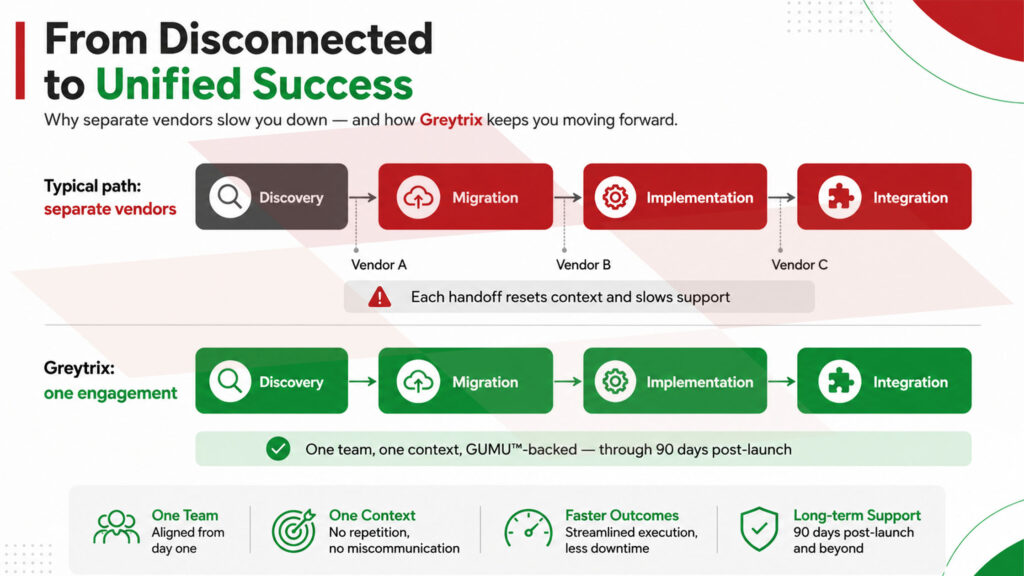
Before hiring any Sage Intacct implementation consultant or specialist, make them answer three things: their experience with your exact legacy system, their integration track record, and what support actually looks like ninety days after go-live.
Myth vs. Reality
Myth: If your data’s clean, random Sage Intacct implementation partners can migrate it.
Reality: clean data still has to reconcile against audit history, and most partners don’t validate lineage until after cutover — when it’s too late to fix quietly.
Myth: Integrations can be reconnected after go-live.
Reality: That’s exactly when parallel-run windows close and rollback stops being an option. GUMUTM is built to launch integrations alongside the core migration, not after it.
Myth: A lower quote means a leaner project.
Reality: it usually means data cleanup and customization carryover weren’t priced at all — and they show up later as change orders, not savings.
Start with Greytrix’s Sage Intacct Implementation Specialists
The right call isn’t picking migration or implementation off a menu. It’s getting someone to look at your systems and tell you, honestly, which one you’re actually facing.
That’s the conversation Greytrix’s Sage Intacct implementation specialists have first — before any proposal gets written, before any number gets quoted. Bring us your legacy system, your integrations, your unreconciled history. We’ll tell you exactly what you’re up against.
Frequently Asked Questions
1. Is a Sage Intacct migration more expensive than an implementation?
Not inherently — cost is driven by data volume, legacy system count, and customization carryover, not by the migration label itself. A well-scoped migration can cost less than a poorly-scoped implementation.
2. How long does a Sage Intacct data migration take?
It depends on transaction volume and how many source systems are involved, but Greytrix scopes every migration around a phased, parallel-run cutover so finance never loses reporting continuity during the transition.
3. Can existing CRM or ecommerce integrations survive a migration?
Yes, when they’re planned for on day one. GUMU™ carries field mapping and data lineage across Salesforce, HubSpot, Shopify, and Sage Intacct, so integrations extend into the new environment instead of being rebuilt.
4. What should I ask a Sage Intacct implementation partner before signing?
The service provider’s track record with your specific legacy system, their direct integration experience, and what their support model looks like in the 90 days after go-live.
5. Does Greytrix handle both migration and implementation?
Yes — as one engagement, with the same team from discovery through post-launch support, backed by GUMUTM integration expertise.
About Us
Greytrix has a wide product range for Sage Intacct- a Cloud ERP. This includes migrations from QuickBooks | Sage 50 | Sage 100 | Sage 300 to Sage Intacct. Our unique GUMU™ integrations include Sage Intacct for Sage CRM | Salesforce | FTP/SFTP | Rev.io | Checkbook | Dynamics 365 CRM | Magento | Rent Manager | Treez | Avalara Avatax | Blackline SFTP. We also offer best-in-class Sage Intacct Development Services, Consulting services, integrated apps like POS | WMS | Payroll | Shipping System | Business Intelligence | eCommerce for Sage Intacct to Sage business partners, resellers, and Sage PSG worldwide. Greytrix constantly develops apps, products, and add-ons to enhance user experience. Sage Intacct add-ons include AR Lockbox File Processing.
Greytrix GUMU™ integration for Sage CRM – Sage Intacct, Sales Commission App for Sage Intacct, and Checkbook.io ACH/Digital Check Payments for Sage powered by GUMU™ are listed on Sage Intacct Marketplace.
The GUMU™ Cloud framework by Greytrix forms the backbone of cloud integrations that are managed in real-time for the processing and execution of application programs at the click of a button.
For more information on Sage Business Cloud Services, please contact us at sagecloud@greytrix.com. We will like to hear from you.