
If you’ve worked in a hospital finance department, you know the headache. Clinical teams run on hospital management systems built for appointments, pharmacy, and billing. Finance runs on ERP platforms built for accounting, receivables, and reporting. Two systems, two worlds and somehow finance has to make sure every rupee lands correctly in the books.
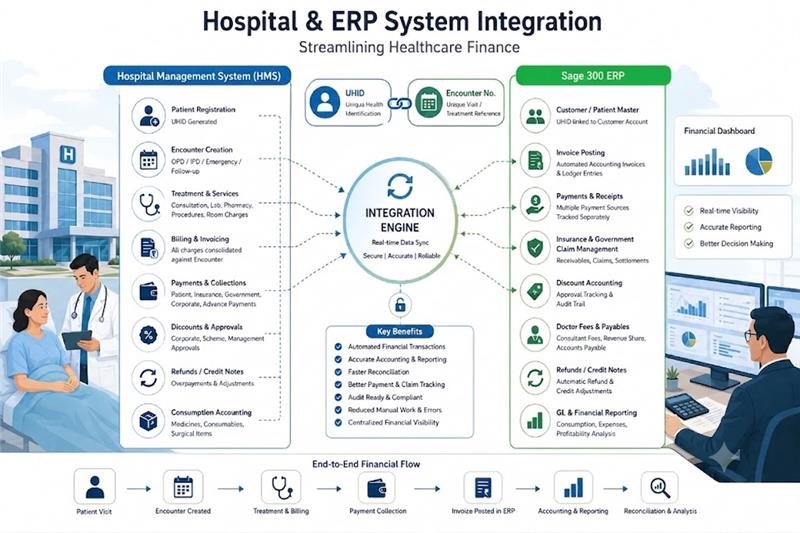
The problem isn’t either system individually. It’s that they were never built to talk to each other. Hospital and ERP integration closes that gap: financial data flows automatically from registration through final settlement, instead of staff manually re-entering it.
Why Encounter Numbers Matter
Walk into a hospital for anything: a quick consultation, a scheduled admission, an ER visit, even a routine follow-up and the system quietly assigns you an Encounter Number behind the scenes. It’s specific to that one visit, nothing more. But that single number ends up doing a lot of heavy lifting: it’s what links every charge, every service rendered, and every payment back to exactly what happened during that particular trip to the hospital.
Understanding UHID
Here’s the distinction that trips people up: the Encounter Number resets every time, but the UHID (Unique Health Identification) doesn’t it follows the patient for as long as they’re associated with the hospital, quietly stitching together their medical history, billing records, insurance details, treatment history, and payment information into one continuous thread.
When it comes to ERP integration, this is the number that really matters for finance. The UHID usually gets mapped to a customer or patient account inside the ERP, which lets the system track someone’s financial history across visit after visit without treating each one like a fresh start.
How Hospital and ERP Integration Works
The integration kicks in the second a patient registers, and it doesn’t stop there — it runs through the entire treatment and billing process. Every transaction that gets created along the way is sent to the ERP automatically, carrying both the UHID and the Encounter Number with it. Nobody has to sit down and key it in later. The records just stay accurate and current on their own.
At registration, a UHID is generated, the patient profile syncs to the ERP and a matching customer account is created or linked. No accounting entries happen yet, but this early handshake ensures every invoice, payment, and adjustment lands correctly later.
Handling Multiple Payment Scenarios
Hospital bills are rarely paid by one party. A treatment might involve the patient:
- An insurance company
- A government scheme
- A corporate employer
Some combination of the above
Splits like 50/50 patient-insurance, or three-way splits with subsidies and advances, are common. A well-integrated ERP records each contribution separately while keeping everything tied to the same encounter making reconciliation far easier.
Managing Advance Payments
Advances collected before admissions or surgeries are automatically recorded, linked to the UHID and encounter, and adjusted against the final invoice no manual tracking required.
- Supporting Government Healthcare Schemes
For patients under government programs, integration allows hospitals to associate subsidy amounts with specific encounters, record receivables, track pending claims, and monitor settlements giving finance real visibility into what’s owed and when.
- Recording Discounts with Complete Transparency
Discounts from corporate agreements, welfare programs, or management approvals are logged with full detail: amount, related encounter, approval details, and final adjusted billing value. That audit trail makes compliance far less painful.
- Separate Workflows for OPD and IPD Billing
OPD visits are simple consultation and diagnostic charges. IPD stays are complex room rent, procedures, pharmacy, nursing, consumables. Integration keeps these workflows distinct where needed while consolidating everything under the correct Encounter Number.
- Doctor Fee Management
Visiting specialists paid via consultations or revenue sharing get automated fee calculations, accounts payable entries, and payouts linked directly to the relevant encounter, cutting manual math and payment errors.
- Automated Invoice Creation
Once treatment ends, the hospital system compiles the final invoice — consultations, room rent, pharmacy, diagnostics, surgery, consumables — and pushes it straight to the ERP, which generates the accounting invoice and ledger entries automatically.
- Simplifying Refunds and Credit Balances
When patients overpay, the ERP compares payments against invoice values, flags excess collections, and generates refund vouchers or credit notes automatically speeding up refunds and keeping records clean.
- Automating Consumption Accounting
Medicines, surgical supplies, and implants consumed during treatment are posted automatically to the right General Ledger accounts medical consumables, pharmacy inventory, surgical supplies, operational expenses giving finance a sharper view of costs.
Benefits of Integrating Hospital and ERP Systems
- The value goes beyond eliminating double entry.
Key benefits includes:
- Automatic sync of billing and financial transactions.
- Greater accounting accuracy.
- Faster reconciliation between hospital and finance systems.
- Better tracking of patient payments.
- Simpler management of insurance and government claims.
- Stronger audit compliance and transparency.
- Less manual data entry and duplication.
- Centralized visibility into patient-related financial data.
About Us
Greytrix – a globally recognized and one of the oldest Sage Development Partners is a one-stop solution provider for Sage ERP and Sage CRM organizational needs. Being acknowledged and rewarded for multi-man years of experience, we bring complete end-to-end assistance for your technical consultations, product customizations, data migration, system integrations, third-party add-on development, and implementation competence.
Greytrix offers unique GUMU™ integrated solutions of Sage 300 with Sage CRM, Salesforce(listed on Salesforce Appexchange), Dynamics 365 CRM, and Magento eCommerce, along with Sage 300 Migration from Sage 50 US, Sage 50 CA, Sage PRO, QuickBooks, Sage Business Vision and Sage Business Works. We also offer best-in-class Sage 300 customization and development services and integration services for applications such as POS | WMS | Payroll | Shipping System | Business Intelligence | eCommerce for Sage 300 ERP and for Sage 300c development services we offer, upgrades of older codes and screens to new web screens, latest integrations using Data and web services to Sage business partners, end users and Sage PSG worldwide.
Greytrix offers 20+ add-ons for Sage 300 to enhance productivity such as GreyMatrix, Document Attachment, Document Numbering, Auto-Bank Reconciliation, Purchase Approval System, Three-way PO matching, Bill of Lading, and VAT for the Middle East. The GUMU™ integration for Dynamics 365 CRM – Sage ERP is listed on Microsoft Appsource with an easy implementation package.
The GUMU™ Cloud framework by Greytrix forms the backbone of cloud integrations that are managed in real-time for processing and execution of application programs at the click of a button.
For more details on Sage 300 and Sage 300c Services, please contact us at accpac@greytrix.com, We will like to hear from you.