
Two manufacturers can implement the same ERP and end up with very different timelines and budgets.
Consider two scenarios. Factory A has one plant, 40 products, tidy bills of materials (BOMs) and one external system to connect. Factory B has three plants, frequently changing multi-level BOMs, supplier-lot traceability needs, and ten years of item data in spreadsheets.
The difference lies in the work required to prepare, configure, and connect the system to each factory’s operations. This guide turns a rough estimate into a defensible number, explaining costs, delays, project risks, and how to choose an honest partner for your manufacturing business.
How Much Does a Sage X3 Implementation Cost for Manufacturing?
Sage X3 manufacturing implementations typically cost US$200,000–$300,000, with complex projects requiring more partner services. Treat this as a reference, not a price list; local rates, taxes, and delivery costs vary by country.
Most budget confusion starts when people use the word “cost” for three different things:
- Implementation services: What the partner charges to design, set up, migrate data, test, train and launch.
- First-year funding: Implementation, plus software subscription, hosting, devices, your own team’s time and other launch costs.
- Total cost of ownership (TCO): All of the above, plus support, upgrades, administration and improvements over several years.
For example-
- A US partner lists a five-user manufacturing bundle from around US$25,000 a year. That is an on-premises subscription example and it excludes implementation.
- An Australian implementation partner, estimates finance, distribution and manufacturing at 150–200 consulting days, with a published investment of AUD 225,000–300,000. Specialized EDI, e-commerce and custom BI work are excluded.
Ask every partner to price these seven categories separately. It is the fastest way to compare quotes fairly.
| Cost category | What it may include | What manufacturers should confirm |
| Software and licensing | Subscription or licence fees, modules, users, environments | What is included in the quote, and what renews? |
| Implementation services | Discovery, solution design, configuration, project management | Which workstreams and how much effort are included? |
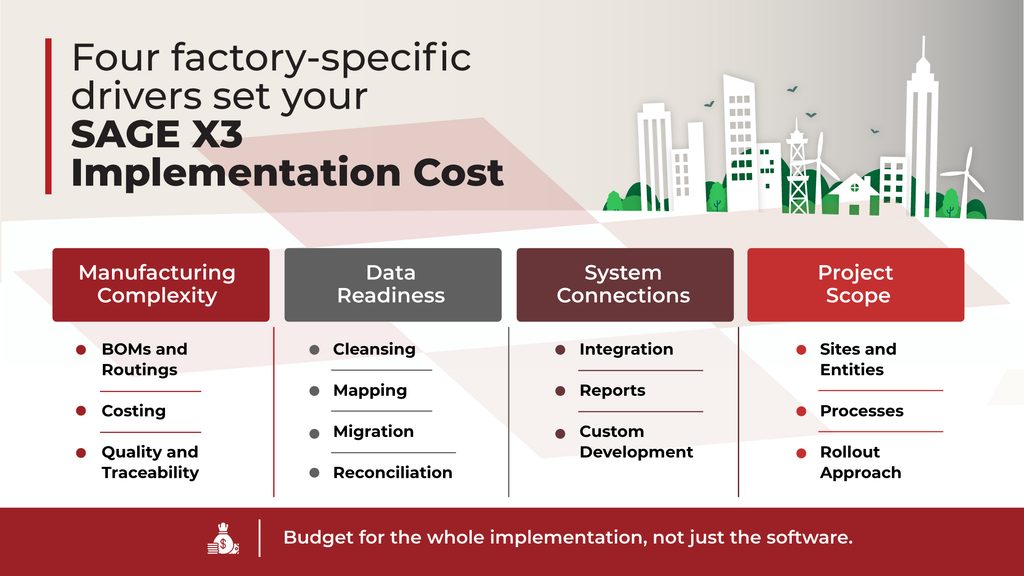
| Manufacturing configuration | BOMs, routings, production planning, costing, quality, traceability | Which manufacturing processes are in scope? |
| Data migration | Cleansing, mapping, trial loads, reconciliation | Which records, history and migration cycles are covered? |
| Integrations and development | External systems, reports, workflows, extensions | What is standard, what needs development, and who maintains it? |
| Testing and training | User acceptance testing, role-based training, cutover rehearsals | Which users and scenarios are included? |
| Internal and ongoing costs | Employee time, backfill, infrastructure, support, enhancements | What must you fund outside the contract? |
Note- This is a budgeting framework, not a price list. Actual costs depend on agreed scope and commercial assumptions.
How Are Sage X3 Implementation Costs and Effort Distributed?
Implementation cost is mostly people’s time. A shared implementation plan covering finance, distribution and manufacturing consulting groups that time into five workstreams:
Workstreams at a glance:
- Planning and analysis: Kickoff, questionnaires, process reviews, gap analysis, and project planning.
- Configuration and data preparation: System setup, configuration, migration planning, and preparation of item, BOM, and stock data.
- Validation and training: User training, functional testing, and validation of finance, distribution, and manufacturing processes.
- Deployment and stabilisation: Cutover preparation, data checks, go-live assistance, and early operational support.
- Project governance: Ongoing coordination of scope, schedule, decisions, dependencies, and risks.
The plan lists tasks, not prices. Hours alone cannot give you a project price, so never convert them into a budget on your own. Always consider scope, rates, assumptions, dependencies and exclusions
How Long Does Sage X3 Implementation Take?
Most manufacturers should plan for roughly 4 to 18 months from planning to go-live, depending on scope.
Go-live is the day your teams start running real orders, stock and production in Sage X3. Stabilization is the weeks after that, when you fix early issues and support becomes routine. A partner that offers post-go-live support can also spot and fix problems in your new system during this period.
| Project profile | Indicative planning range | What to investigate |
| Defined, single-site deployment | Around 4–7 months | Standard scope, clean data, limited integrations, available users |
| Broader manufacturing implementation | Around 6–12 months | Production complexity, customisation, migration, testing |
| Multi-site or multi-country programme | Around 9–18 months or longer | Site differences, intercompany flows, localisation, rollout sequencing |
Note – These are indicative planning ranges from third-party research (ERP Research and partner guidance), not delivery guarantees. Confirm assumptions, timelines, and post-go-live support with your implementation partner.
The ranges overlap on purpose. “Standard” and “complex” aren’t contract terms, and a small factory with tangled workflows can take longer than a bigger one with clean data.
To read these ranges correctly, separate two similar ideas: effort and duration. Effort is different from duration. Let’s look at an example.
Building a house may take 300 worker-days, but not 300 days: crews work in parallel, while some tasks depend on others. ERP projects work the same way.
- Effort is how many days of consultant time the work needs (person-days).
- Duration is how many calendar days pass between kickoff and go-live.
Take two real numbers. A partner estimate of 150–200 consulting days—or about 50 person-days for a limited-scope Rapid Deployment Kit—doesn’t mean the same number of calendar days.
The timeline depends on your decisions, data readiness, plant staff availability for testing, and production calendar. Estimates assume internal resources; the undated sample plan supports effort discussions, not calendar commitments.
Why Manufacturing Requirements Change the Budget and Timeline
Sage X3 already has the tools a factory needs. The effort comes from setting them up to match your plant and loading trustworthy data. A simple factory configures Sage X3 ERP. But a complex one has to design, integrate, test and prove it.
| Manufacturing requirement | Why it adds effort |
| Complex BOMs and revisions | Accurate structures and version control |
| Routings and work centres | Agreed production steps and resources |
| MRP and scheduling | Reliable demand, lead times, capacity |
| WIP and costing | Material, labour and overhead treatment |
| Batch or serial traceability | Tracking and end-to-end testing |
| Multi-site manufacturing | Site rules, transfers, joint testing |
| MES, WMS or other integrations | Interface design, data ownership, support |
| Regulated or specialised processes | Extra validation or add-on applications |
Sage X3 supports quality processes and lot traceability, but does not guarantee regulatory compliance. Before finalising scope, confirm whether Sage X3, an add-on, or custom development can provide required electronic batch records, signatures, or MES functionality.
A Sage X3 implementation moves through six connected phases, from planning to a stable go-live. For a step-by-step walk-through of each phase, read our guide to Sage X3 implementation phases, cost.
Selecting a Sage X3 Partner Who Understands Your Factory
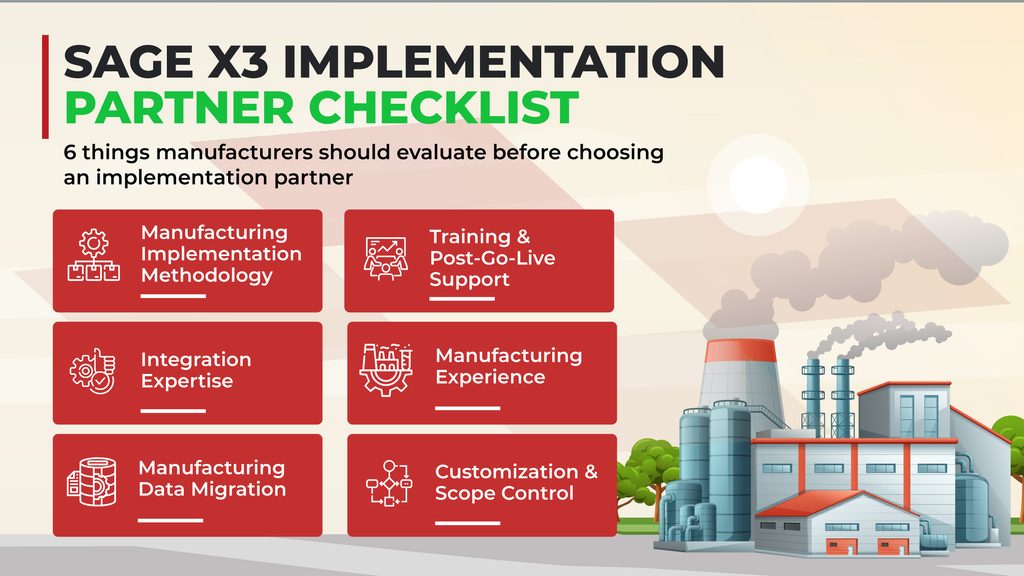
Sage says its partners implement X3, train your teams and provide ongoing support. Choose a partner based on relevant manufacturing experience, delivery scope, data migration, testing, and post-go-live support—not just the quality of the sales demo. Six things to check for one, is given below.
| What to check | Ask this | A good sign |
| The actual team | “Who exactly will work on my project, and for how many days?” | Named consultants with relevant credentials |
| Scope and exclusions | “What is not in this quote?” | Exclusions listed in plain words |
| Data migration | “Who cleans the data, and how many trial loads are included?” | Defined data objects and rehearsals |
| Integrations | “Which interfaces are in scope, and who supports them after upgrades?” | Named owners and clear support terms |
| Testing | “Will you test a full production-to-invoice flow?” | Scenario-based tests with acceptance criteria |
| Support | “What happens after go-live?” | Defined hypercare and escalation routes |
And Greytrix meets your need for a supportive implementation partner. Because:-
Greytrix is a Sage X3 partner that covers the full journey: scoping, requirements, implementation, user acceptance testing, go-live, tailored training and ongoing support. Its published migration approach runs from data analysis and mapping through sandbox imports, validation and user adoption.
- Integration-first approach – Greytrix developed GUMU™, which Sage’s Marketplace lists as an accredited integration framework for connecting Sage X3 to other business applications. Fewer re-keyed records between systems means fewer errors.
- Implementation and migration: scope definition, data mapping, validation, testing, training, and support.
- Integration and extensions: Greytrix offers GUMU™ integration; Catch-Weight Add-On for businesses tracking both item counts and actual weight; and ShipEazy listing connects Sage X3 to shipping carriers for rates, labels and tracking.
- Functional and technical delivery: the ability to address process needs and technical changes.
Verify its current partner status in your region, the credentials of the consultants proposed for your project, and the scope of its stated ISO 27001:2022 and SOC 2 reports. Credentials earn a place on your shortlist.
Build the Estimate Around Your Factory, Not a Generic ERP Benchmark
A benchmark tells you what other factories paid. It cannot tell you what yours needs.
A reliable Sage X3 estimate starts with your manufacturing processes, data, integrations, and implementation scope—not a generic ERP benchmark.
Greytrix supports Sage X3 implementation, configuration, migration, integration, development, training, and ongoing support. Discuss your requirements with the team to identify the scope, dependencies, and delivery considerations that should shape your implementation plan.
Frequently Asked Questions:
1. How much does Sage X3 implementation cost for a manufacturing company?
US partner estimates vary by scope. Some place typical implementation services around US$200,000–US$300,000, with more complex projects costing more. Software, hosting, internal staff time, and other expenses may be additional. Request a bottom-up estimate by workstream; final pricing depends on modules, plants, data condition, and integrations.
2. How long does a Sage X3 implementation take?
Planning ranges are about 4–7 months for a defined single-site project, 6–12 months for broader implementations, and 9–18 months or more for multi-site programmes. These are indicative, not guarantees. Agree in writing where the clock starts and whether it stops at go-live or after stabilisation.
3. What factors affect Sage X3 implementation cost?
The biggest factors are manufacturing scope, data readiness, integrations, number of sites, customization, and how much time your own people can give. The number of users matters far less than most buyers expect.
4. Does a multi-site Sage X3 implementation take longer?
Usually, yes, a multi-site Sage X3 implementation takes longer. Each plant adds its own settings, transfers between sites or companies, extra testing and more training. Sage X3 supports multi-site planning and transfers, and a shared template with documented local exceptions keeps the extra time down.
About Us
Greytrix – a globally recognized and one of the oldest Sage Development Partners is a one-stop solution provider for Sage ERP and Sage CRM organizational needs. Being acknowledged and rewarded for multi-man years of experience and expertise, we bring complete end-to-end assistance for your technical consultations, product customizations, data migration, system integrations, third-party add-on development, and implementation competence.
Greytrix has some unique integration solutions developed for Sage CRM with Sage ERPs namely Sage X3, Sage Intacct, Sage 100, Sage 500, and Sage 300. We also offer best-in-class Sage ERP and Sage CRM customization and development services to Business Partners, End Users, and Sage PSG worldwide. Greytrix helps in the migration of Sage CRM from Salesforce | ACT! | SalesLogix | Goldmine | Sugar CRM | Maximizer. Our Sage CRM Product Suite includes addons like Greytrix Business Manager, Sage CRM Project Manager, Sage CRM Resource Planner, Sage CRM Contract Manager, Sage CRM Event Manager, Sage CRM Budget Planner, Gmail Integration, Sage CRM Mobile Service Signature, Sage CRM CTI Framework.
Greytrix is a recognized Sage Champion Partner for GUMU™ Sage X3 – Sage CRM integration listed on Sage Marketplace and Sage CRM – Sage Intacct integration listed on Sage Intacct Marketplace. The GUMU™ Cloud framework by Greytrix forms the backbone of cloud integrations that are managed in real-time for the processing and execution of application programs at the click of a button.
For more information on our integration solutions, please contact us at sage@greytrix.com. We will be glad to assist you.