Finance and tax teams in Saudi Arabia and the United Arab Emirates are dealing with two e-invoicing compliance timelines at the same time. In Saudi Arabia, ZATCA Phase 2 integration is being rolled out in waves across the taxpayer base, pulling thousands of businesses into a mandatory clearance system. In the UAE, the Ministry of Finance published detailed implementation guidance in February 2026 and confirmed the phased go-live calendar.
UAE E-Invoicing 2026: What PINT-AE and Peppol Mean for Your Business

Businesses operating across Saudi Arabia and the UAE now have two major e-invoicing compliance deadlines to prepare for. Delaying ERP readiness could result in invoice processing failures and regulatory non-compliance.
The UAE’s mandatory e-invoicing framework is advancing through 2026 -large taxpayers (AED 50 million+ revenue) must appoint an Accredited Service Provider by 30 October 2026, ahead of the voluntary pilot from July 2026 and mandatory go-live from January 2027, and for business leaders operating B2B and B2G transactions in the UAE, the compliance window is narrowing. Unlike simpler e-invoicing mandates, the UAE’s model is based on the Peppol network architecture and the PINT-AE standard -a technical framework that requires more than a system update. It requires your ERP to work within a structured digital exchange ecosystem.
What the UAE E-Invoicing Framework Actually Requires
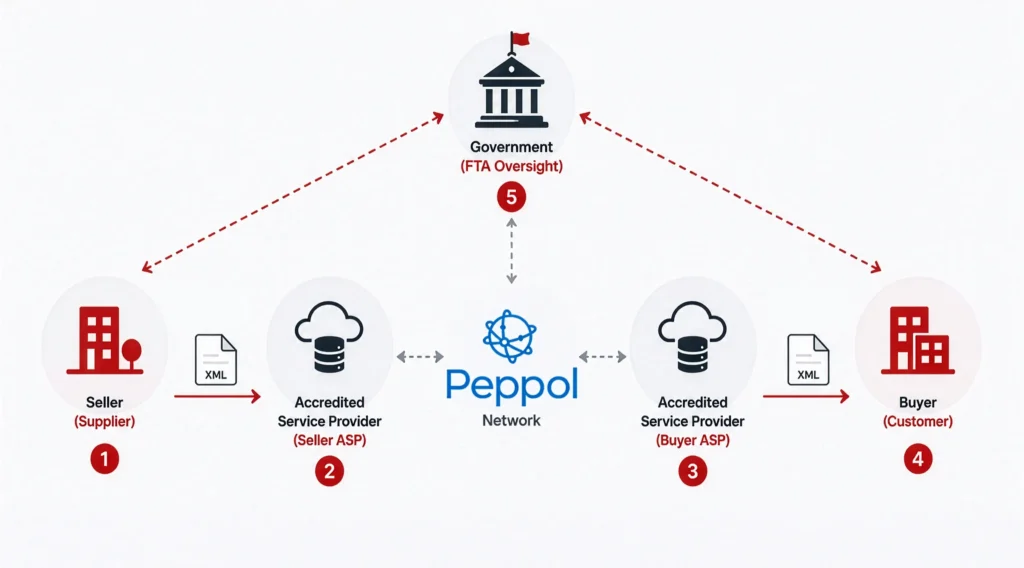
The UAE e-invoicing mandate uses the Peppol 4-corner model -in the UAE adapted to a 5-corner model that includes an additional governmental oversight node. In practical terms, this means:
- Invoices must be structured in the PINT-AE format -a UAE-specific adaptation of the Peppol International billing standard
- Businesses must connect to the Peppol network through an Accredited Service Provider (ASP) -a certified technology intermediary
- Both buyer and seller must be on the network for B2B transactions to be exchanged electronically
- B2G transactions -invoices to government entities -follow a separate, often more immediate compliance requirement
The ASP selection and integration process is not a minor configuration change. It involves your ERP generating invoices in PINT-AE XML format, transmitting them through your ASP to the Peppol network, and receiving status and validation responses -all within the ERP workflow.
The Business Impact of Getting This Wrong
For UAE businesses supplying government entities, the consequence of non-compliance is straightforward: invoices will not be accepted. For B2B businesses, the consequence is a growing gap between your invoicing process and the digital exchange system your customers and suppliers will increasingly require. UAE Federal Tax Authority guidelines make the compliance expectation clear, and ASP deadline extensions -though they have occurred -should not be treated as relief.
The businesses most at risk are those running ERP systems that were not designed with open API architecture -systems where building a PINT-AE compliant output requires expensive custom development rather than a supported integration pathway.
Why Sage ERP Is Well Positioned for UAE E-Invoicing
Sage X3 and Sage Intacct are both built on API-first architecture designed to support the kind of structured third-party integration that Peppol-based e-invoicing through an ASP requires. Greytrix Middle East has active e-invoicing implementations in the region -including ZATCA Phase 2 for Saudi Arabia -and is developing the UAE PINT-AE integration pathway for Sage ERP customers as the mandate progresses.
A well-structured Sage ERP e-invoicing integration for the UAE will deliver:
- PINT-AE compliant XML invoice generation from within your Sage ERP -automatically
- ASP connection through a certified provider -handling the Peppol network layer
- Status tracking and validation response captured inside your ERP transaction record
- Full audit trail of every transmitted invoice -ready for FTA review
- Existing UAE FTA VAT compliance retained -e-invoicing layer added without disrupting current processes
Suggested move for business owners
- Confirm whether your business falls within B2B or B2G scope -the compliance timelines and technical requirements differ
- Identify your current ERP’s capacity to generate PINT-AE format invoices -ask your ERP partner directly
- Evaluate ASP options -select a UAE FTA-accredited provider that integrates with your ERP
- Begin a readiness assessment now, not when a deadline is announced -implementation timelines are longer than most businesses expect
Conclusion
The UAE’s e-invoicing mandate represents a fundamental shift in how business transactions are recorded and exchanged digitally. For business leaders in the UAE, the strategic question is not whether to comply, but how to build the compliance infrastructure into your ERP architecture correctly -so that when the mandate reaches your specific business segment, you are ready. Greytrix Middle East is available to assess your current ERP position and map your readiness pathway.
About Greytrix Middle East
Greytrix Middle East is a Sage Platinum Partner with over 25 years of global ERP experience, delivering Consulting, Implementation, Development, and Support services for Sage X3, Sage 300, Sage Intacct, Sage 300 People (HRMS), and Sage CRM across the UAE, Saudi Arabia, and the broader Middle East. We serve industries including Manufacturing, Distribution, Oil and Gas, Healthcare, Hospitality, and Services.
Contact Us
sales@greytrix.com | www.greytrix.com/middle-east
References:
- Avalara -UAE E-Invoicing Mandate 2026 Readiness: avalara.com/blog/en/europe/2026/03/uae-e-invoicing-mandate-2026-readiness-asp-pint-ae.html
- EDICOM -UAE E-Invoicing Guidelines v1.1: com/blog/united-arab-emirates-electronic-invoicing-project
- RTC Suite -UAE E-Invoicing B2B/B2G/B2C Timeline: rtcsuite.com/e-invoicing-uae/
- Henry Club -UAE E-Invoicing 5-Corner Model: ae/tax-compliance/einvoicing-uae/
- Fiscal Solutions -ASP Deadline Context: fiscal-requirements.com/news/5702
- Greytrix Middle East e-invoicing page: greytrix.com/middle-east/contact-us/
FAQs
ZATCA notifies each taxpayer group at least six months before their integration deadline. You can also check the official ZATCA rollout phases page to see how waves are grouped by revenue threshold.
No. The mandate applies to all businesses transacting in the UAE regardless of VAT registration status, unless your activity falls under a specific exclusion. Participation is based on a Tax Identification Number, not VAT registration.
PINT AE stands for Peppol International Invoice -UAE. It is the structured XML schema mandated by the UAE Ministry of Finance, specifying the exact mandatory data fields that must be present. PDFs do not satisfy this requirement.
Sage has the capability -the question is configuration. Producing ZATCA-compliant XML and connecting to UAE ASP infrastructure requires specific implementation work. That is what Greytrix Middle East does. Contact our team to discuss your setup.
An ASP is a Ministry of Finance-approved intermediary that validates invoice data against the PINT AE schema and transmits it through the UAE e-invoicing network. Businesses must formally appoint an ASP before their applicable deadline.
Our Partnerships