Tag Archives: Sage X3 Functional blogs

Destination Parameter issue in Report printing

Some times in freshly installed Sage X3, when trying printing report and attaching the workflow. The basic functionality of the customization is to send the invoice to the customer (Pending payments). The customizations requirements were to send the reminder payments. One of clients freshly installed X3 when customized with reminders workflow. The workflow is set… Read More »

How to create combine pick ticket for multiple order in Sage X3

If you want to create a single pick ticket by combining multiple orders then sage x3 provide you a way to achieve this. Below is the demonstration of how can we create a consolidated pick ticket. Suppose one pick ticket needs to be created for 2 orders then please check below steps: Create Order 1… Read More »

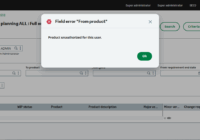
How to solve Error ‘Product unauthorized for this user.’ in Enterprise planning

Resolving the “Product unauthorized for this user.” Error in Enterprise Planning Issue While working in Enterprise Planning, users may encounter the following error: Product unauthorized for this user. This error occurs when the logged-in Enterprise Planning user is not assigned as either the Buyer or the Planner for the selected product-site record in Sage X3.… Read More »

How to solve Unknown error: ‘NOK’ while configuring Sage X3 Console

When setting up a new Sage X3 V12 Patch 39 environment on a cloud-based Windows Server, we encountered an unexpected error while creating a new solution in the Sage X3 Configuration Console. The Configuration Console displayed the following message: Connection failure Unknown error: NOK At first, the error did not provide any useful information about… Read More »

Streamlining Freight Shipment in Sage X3 using GUMU™ ShipEazy

For many Sage X3 users, the shipping process remains a manual process. From toggling between carrier portals to manually typing in tracking numbers, service type and managing complex hazmat products paperwork, the margin for error is high, and lack of real-time visibility can directly impact customer satisfaction and operational costs.   Freight shipment is more… Read More »

Handling LTL shipments in Sage X3 via GUMU ShipEazy

As businesses look for smarter and more cost-effective ways to move freight, Less-Than-Truckload (LTL) shipping has become an increasingly strategic choice. With the new LTL feature in ShipEazy for Sage X3, managing partial truckload shipments is now easier, faster, and more streamlined than ever. How GUMUTM ShipEazy Enhances LTL Shipping Inside Sage X3 ShipEazy brings… Read More »

Sage X3 Copilot Installation & Setup Guide (2025R2)

Introduction With the growing role of AI in ERP systems, Sage Copilot enhances decision-making, automation, and user productivity inside Sage ecosystem.This guide explains the prerequisites and setup process required to successfully install and configure Sage X3 Copilot for the 2025R2 release. Prerequisites These prerequisites ensure system compatibility, secure connectivity, and smooth Copilot performance. Installation &… Read More »

Catch Weight in Manufacturing: Managing Variable-Weight Production Accurately

In many manufacturing industries, products do not have a consistent or fixed weight. Although they are processed and tracked in standard units such as pieces, bags, boxes, or pallets, their true cost, material consumption, and sales value are determined by the actual weight. This is where Greytrix’s Catch Weight Management becomes essential for achieving accuracy,… Read More »

How to Manage Variable-Weight Products in Sage X3

Industries like food processing, meat, seafood, dairy, and specialty chemicals deals with products that never have a fixed weight. A carton may look the same, but the weight inside can change every time. Yet, many businesses still manage these products using standard units such as pieces, cartons, or batches—while pricing, costing, and billing are driven… Read More »

How to create Bill of Lading against Delivery in Sage X3

A Bill of Lading is a legal document used to show the agreement between the shipper and the carrier. Trucking companies need this document to move goods. It usually includes the freight class, description, number of packages, weight, volume, and other shipping details. For deliveries, a Bill of Lading can be created from the delivery… Read More »